Pointless Audio / Plugins / SnakePit
Tube Channel Strip · Tube strip, our own
SnakePit
One tube makes the character. The rest of the chain feeds it.
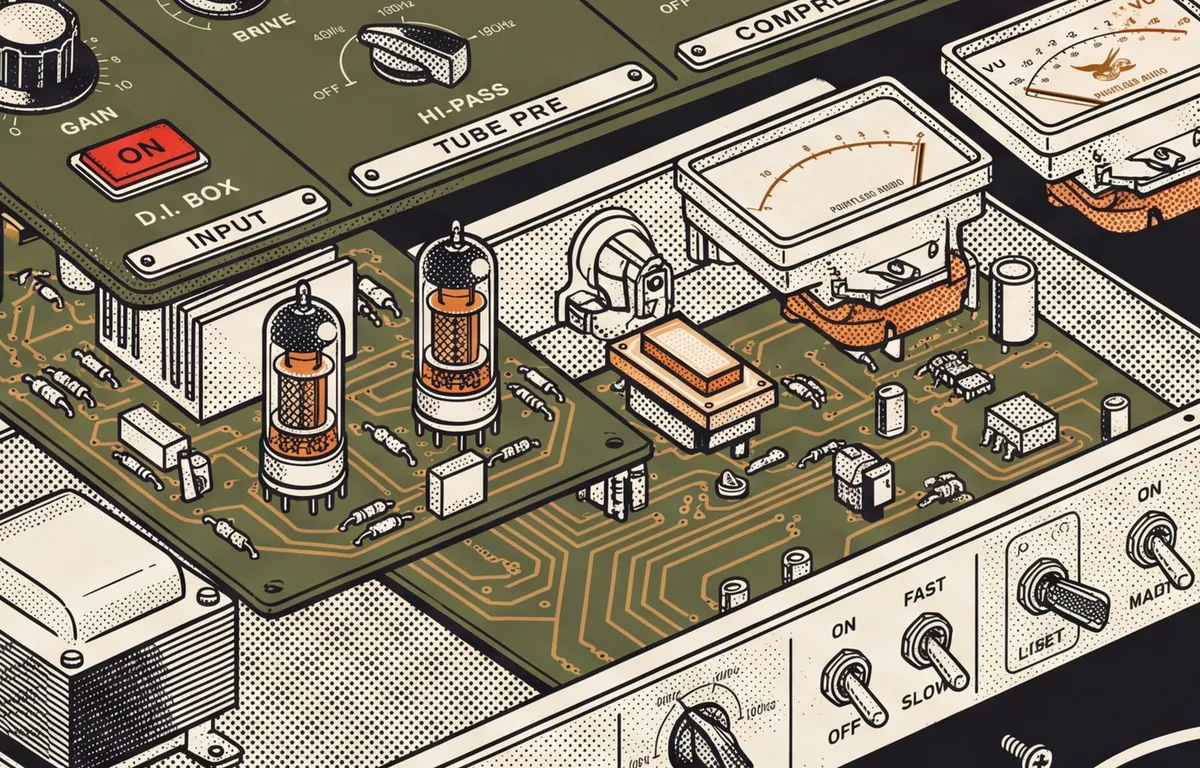
A physical model of a triode — an original design — makes the harmonics. The chain exists to feed it at the right level: an iron DI front end, two compressors in series, tape polish, an output transformer. It sounds like one machine — and it doesn’t care what you feed it.
- Machine
- Our own tube channel strip
- Version
- v1.5.1
- Runs on
- VST3 · AU · CLAP — macOS, Windows, Linux
- License
- Pay once. No iLok, no account, no subscription
Or all six for €49, SnakePit included. Get all six · Money back in 14 days if it doesn’t run on your system.
4.9 from 54 ratings on Gumroad

What people say
…I particularly like the Snakepit (Tube Channel strip), easy to use and sounds great.
That´s a gem! I love the saturation and the unobtrusive compression does a good job too
Hear it
The same take twice, level-matched. Switch the plugin off and on while it plays.
Bass
Recorded bass, hip-hop groove
Only the bass goes through SnakePit; the drums stay dry. With the plugin the note holds longer, the finger attack rounds off and there is more body underneath.
Drums
Post-punk drums on the bus
The kick gets more body, the hits round off and the cymbal tails come up. When the bass comes in, the drums sit in front without getting louder.
Full mix
The whole mix, glued
The whole track through the plugin, set to glue without dirt: the mix tightens, the peaks drop almost 2 dB at the same level, the hits round off a touch and the tone stays the same.
What it does
One tube makes the character
A physical model of a triode — an original design, not a copy of anything — is the single place where the harmonics are made. DRIVE sets how hard it’s pushed; COLOR sets the tone of the whole machine, dark to bright. Everything else exists to feed it well.
Start at the lamps
Three lamps above GAIN: green means signal, yellow means you’re at the level the plugin was voiced at, red watches the peaks. Set GAIN so yellow is on, then forget it. AUTO GAIN holds the output steady, so an A/B against bypass compares tone, not volume.
Two compressors in series
PEAK is the fast, FET-style one: grip on the transients. BODY is the slow, optical-style one: weight on the sustain. Both knobs set how much, never how fast. MIX blends in the dry path for parallel compression; FAST/SLOW sets the release of the slow stage.
Iron at both ends
An iron DI stage you can switch off, and a high-pass (Off/40/80/120) ahead of the valve, so it protects as well as tidies. At the other end: TAPE polish, an HF AIR shelf, an output transformer with a gentle rise around 90 Hz, and a SOFT LIMIT seat belt.
Built around a bass DI
It began as a bass DI, and that low-end rise is most of why a bass sits in a mix instead of just getting louder. But the valve doesn’t know what you feed it: drums, brass, voice, synth bass and a mix bus all work.
16 parameters, 8 presets
From Clean Lift to Bass DI to Drum Bus — eight deliberately conservative starting points. None of them touches GAIN or MASTER: the input level is yours, set with the lamps.
The heritage
SnakePit sounds like one machine: a single place where the harmonics are made, and a chain built so that place always gets the right level. That’s why GAIN and the lamps come first, why AUTO GAIN exists, and why the compressors sit after the valve instead of fighting it.
The details follow the same logic. The high-pass sits ahead of everything non-linear, because a very low note that reaches a valve comes back out as its own harmonics — you lose the fundamental and keep the buzz. And the low end rises gently around 90 Hz before falling away below: that shape isn’t an equalizer, it’s what iron does at the bottom of its range.
SnakePit is an original design, inspired by the behavior of valve and transformer circuits in general. It is not an emulation of, affiliated with, or endorsed by any manufacturer. One machine, pushed as hard as you like.
“The Snake Pit” was the nickname of Studio A at Motown’s Hitsville U.S.A. in Detroit. SnakePit was built around a bass DI with that kind of chain in mind; it is not a copy of anything in it.
Motown and Hitsville U.S.A. are trademarks of their respective owners. Pointless Audio is not affiliated with, endorsed by, or sponsored by them. The name refers to the studio’s nickname.
Specs
- Formats
- VST3 + AU + CLAP
- Platforms
- macOS (Universal) + Windows 10+ (VST3 + CLAP) + Linux x86_64 (VST3 + CLAP)
- Version
- v1.5.1
- License
- Perpetual — no account, no iLok, no subscription
- Manual
- Online manual · PDF
What’s new in 1.5
For those who have it
The compressor works across the whole knob.
- PEAK and BODY
- Both now start where the knob starts. Before, BODY did nothing until about halfway and PEAK very little until a third. Now around 30 % each is a light couple of decibels, and it grows evenly to heavy at the top. The compressor works the same with AUTO GAIN on or off, and DRIVE no longer moves its threshold.
- Presets
- The factory presets are retuned to match. Bass Tight and Drum Bus sound as before; Warm Glue, Bass DI, Vocal and Brass now use the slow compressor the way they were meant to.
- Start
- SnakePit starts on its settings from the first sample (the first 20 ms used to fade in from silence), and user presets no longer store BYPASS.
Already have SnakePit? Same Gumroad link: download it again. With PEAK and BODY at zero the sound is the same as 1.4.5. Projects that use PEAK or BODY open with the new compressor and will sound more compressed than you left them: turn PEAK or BODY down to taste.
How to get it
-
01
Get it on Gumroad
Checkout runs on Gumroad, which handles payment and VAT. The download link lands in your inbox.
-
02
Download the zip
Inside: VST3 + AU + CLAP builds and the manual as PDF. macOS builds are signed and notarized. Linux is a separate tar.gz.
-
03
Install, rescan, done
macOS: run the signed installer in the zip and pick your formats. Windows: copy the plugin into your plugin folder. Linux: extract the tar.gz, copy the .vst3 folder to ~/.vst3 and the .clap file to ~/.clap; README.txt inside has the steps. Rescan in your DAW. No account, no activation. The manual has the exact paths for macOS and Windows.
Questions
How do I install it?
On macOS, run the installer inside the zip: it is signed and notarized, and lets you pick the formats. On Windows, copy each format into your plugin folder. On Linux, extract the tar.gz and copy the .vst3 folder to ~/.vst3 and the .clap file to ~/.clap, as README.txt inside the package explains. Then rescan in your DAW. The manual has the exact paths for macOS and Windows; Linux is in README.txt.
Do I need an account, a dongle, or an internet connection?
No account, no iLok, no subscription, no activation. Once installed it runs fully offline.
Does it work in my DAW?
Any host that loads VST3, AU or CLAP: Logic Pro, Ableton Live, Reaper, Bitwig, Cubase, Studio One, FL Studio and friends. No AAX — Pro Tools is not supported.
Does it run on Linux?
Yes: x86_64, VST3 and CLAP, no AU. It needs glibc 2.38 or newer (Ubuntu 24.04+, Debian 13, Fedora 39+); Ubuntu 22.04 and Debian 12 are too old. The CLAP build is experimental. Same sound engine as the macOS and Windows builds. If something doesn’t load or sounds wrong, write to hello@pointlessaudio.studio.
Windows says the file is from an unknown publisher.
Windows builds are not code-signed yet, so SmartScreen may warn on first run. The zip you download from Gumroad is the zip we built — choose “Run anyway” or unblock the file in Properties.
Refunds?
If it doesn’t run on your system, you get your money back. 14 days. Write to hello@pointlessaudio.studio — most problems are quick to fix, and if yours isn’t, the refund goes through Gumroad.
Have updates been free?
So far, yes: every update has been free, delivered through the same Gumroad link.
€24
Pay once. No iLok, no account, no subscription. If it doesn’t run on your system, you get your money back. 14 days.
More machines
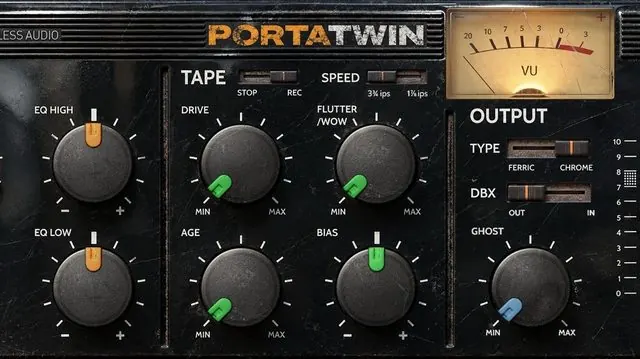
All six for €49PortaTwin
Four-track, 1987
The preamp clips early. The tape wears out. We kept both.
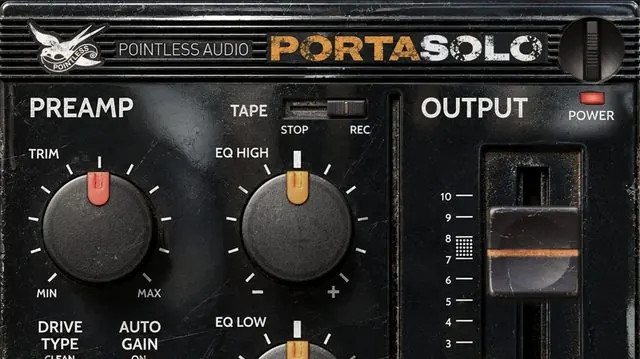
€29BuyPortaSolo
One channel of PortaTwin
One channel. The tape, set once. Free.
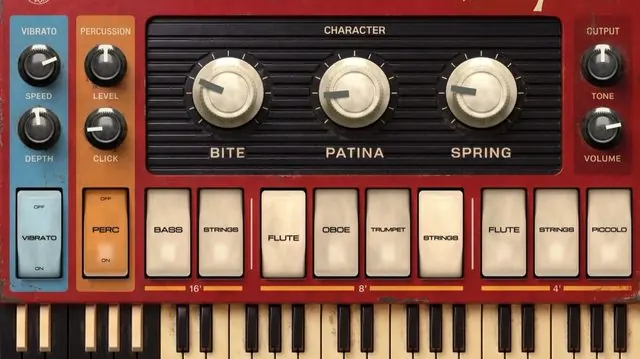
FreeDownloadCompatto
Combo organ, 1960s
We modeled the organ, and the sixty years since.
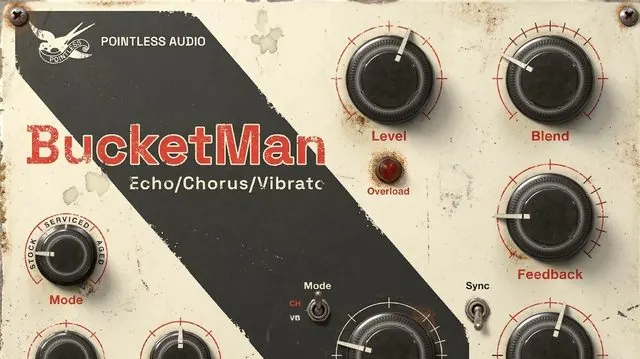
€24BuyBucketMan
BBD pedal, 1980
Bucket-brigade delay and chorus, from soft repeats to runaway feedback.
€19BuyFerrotank
Spring tank, 1961
Strike, pluck or damp the springs, or play them from a MIDI key. The drip is the point.
€19BuyAlphaRail
Synth preamp, 1971
The 2600’s preamp, rebuilt from the schematic. Free.
FreeDownload