Pointless Audio / Plugins / AlphaRail
Op-Amp Preamp · Synth preamp, 1971
AlphaRail
Three gain ranges. Push it past spec.
An op-amp preamp inspired by the ARP 2600 (1971), now with two engines. In Classic, bandwidth crashes and slew gives up — gloriously.
- Machine
- The preamp of a 1971 modular synth
- Version
- v0.5.2
- Runs on
- VST3 · AU · CLAP — macOS, Windows, Linux
- License
- Free. The whole plugin, not a demo. No account, no iLok
4.9 from 46 ratings on Gumroad

What people say
…AlphaRail strips away beautifully at harmonics - In a Very 1970's Suspense Soundtrack way!
I downloaded it out of curiosity, and I was surprised to find that everything was better than I expected.
Hear it
The same take twice, level-matched. Switch the plugin off and on while it plays.
Bass
Recorded bass, pushed
Only the bass goes through AlphaRail; the drums stay dry. Harmonics appear and the note squares off at the same level, so it cuts through where the kick covered it.
Bass
Saturated synth bass
Only the bass goes through AlphaRail; drums and percussion stay dry. It saturates and fills with harmonics at the same level, and when the keys come in you still hear it underneath.
Organ
Garage organ, dirtier still
The riff growls, the drone fills with harmonics and the notes compress. With bass and drums, the organ bites harder without getting louder.
Guitar
Guitar into the preamp
Each strum gets more harmonics and the attack compresses, like a preamp pushed hard.
What it does
Two engines
The CIRCUIT button picks one. Circuit, the default, is built from the preamp’s service-manual schematic and the datasheet of its op-amp, noise included. Classic is the AlphaRail of v0.4: the stage pushed past its 1971 specification.
Three RANGE positions
×10, ×100, ×1000: 20, 40 and 60 dB. They’re voicings, not volume. In Classic, one hits a bandwidth wall at 1 kHz. We kept it.
Three failure modes, at once
Push a 1971 op-amp past spec and two things happen together: the gain-bandwidth product collapses and the slew rate runs out. Classic adds a third on purpose: one side of the wave clips before the other. That lopsided clip is where the second harmonic comes from — a choice made for the sound, not a measurement of the chip.
Not warm, not tube
This is not transistor saturation with a sweater on. It is what an op-amp sounds like when you ask it to do impossible things. At ×1000 Classic stops being a preamp and becomes a lo-fi shaper with opinions.
Level-matched from the start
New instances open in the Circuit with AUTOGAIN on: on pink noise at −18 dBFS the default settings come out within 0.1 dB of the dry signal. You hear the color, not the volume.
Not a demo — the whole plugin
Free. Nothing is locked, nothing expires. So far, updates have come through the same Gumroad link.
The heritage
AlphaRail is inspired by the ARP 2600 (1971), the semi-modular behind R2-D2’s voice: Ben Burtt made it by pushing his own voice through the synth’s resonant filter, with a tape-recorder microphone inside the machine. Its documented users are a scene rather than a single record — Stevie Wonder, Pete Townshend, Edgar Winter, Jean-Michel Jarre, Weather Report, Depeche Mode, Joy Division, Nine Inch Nails. None of these artists used or endorsed this plugin.
AlphaRail models one specific stage of that machine — the input preamp op-amp pushed past its specification. Not the filter, not the oscillators, not the spring reverb. The op-amp character, isolated and made playable on any source.
Closed-loop preamps like this were never meant to be musical. They were utility amplifiers, built to route external signals into the synth voice. Pushing them was the mistake that turned out to be the sound.
ARP and ARP 2600 are trademarks of Korg Inc. Pointless Audio is not affiliated with, endorsed by, or sponsored by Korg. Product names are used solely to describe the hardware that inspired this plug-in.
Specs
- Formats
- VST3 + AU + CLAP
- Platforms
- macOS (Universal) + Windows 10+ (VST3 + CLAP) + Linux x86_64 (VST3 + CLAP)
- Version
- v0.5.2
- License
- Perpetual — no account, no iLok, no subscription
- Manual
- Online manual · PDF
What’s new in 0.5
For those who have it
A second engine, built from the original preamp’s schematic, and new defaults.
- Circuit
- A new engine with its own button. GAIN is the input pot ahead of the op-amp, on a log taper; RANGE switches the gain network. A soft limiter before the stage and a soft saturator after it are the plug-in’s own design, not a measurement of the chip.
- Classic
- The AlphaRail of v0.4, unchanged. The engine is saved with the project, with presets and with the A/B snapshots; latency is the same as in v0.4.
- Noise
- The Circuit has its own noise: with AUTOGAIN off, about −113 dBFS A-weighted at ×10, −93 at ×100 and −73 at ×1000. Classic has none.
- Defaults
- New instances open in the Circuit with AUTOGAIN on and OUTPUT at 0 dB. The factory presets load the Circuit, each within 0.1 dB of the dry level. Hovering over GAIN or OUTPUT shows its value.
- CPU
- About 3.9 % of one core at 48 kHz at the default settings, against about 1.2 % for Classic. Driven hard, the Circuit costs more: up to about 11 % in the worst case we measured.
- Fixed
- A NaN or infinite sample from earlier in the chain no longer leaves a channel invalid until the plugin is reloaded. Save preset opens inside the plugin window. Safe with oversized buffers from offline bounce and track freeze. A workaround for the dead corner in Logic, GarageBand and MainStage on macOS Tahoe.
Already have AlphaRail? Same Gumroad link: download it again. Projects and presets saved with 0.4.x open in Classic with the same settings. To try the Circuit on an old project, turn AUTOGAIN on before pressing CIRCUIT.
How to get it
-
01
Get it on Gumroad
Checkout runs on Gumroad. It’s free: enter 0 in the price field. The download link lands in your inbox.
-
02
Download the zip
Inside: VST3 + AU + CLAP builds and the manual as PDF. macOS builds are signed and notarized. Linux is a separate tar.gz.
-
03
Install, rescan, done
macOS: run the signed installer in the zip and pick your formats. Windows: copy the plugin into your plugin folder. Linux: extract the tar.gz, copy the .vst3 folder to ~/.vst3 and the .clap file to ~/.clap; README.txt inside has the steps. Rescan in your DAW. No account, no activation. The manual has the exact paths for macOS and Windows.
Questions
How do I install it?
On macOS, run the installer inside the zip: it is signed and notarized, and lets you pick the formats. On Windows, copy each format into your plugin folder. On Linux, extract the tar.gz and copy the .vst3 folder to ~/.vst3 and the .clap file to ~/.clap, as README.txt inside the package explains. Then rescan in your DAW. The manual has the exact paths for macOS and Windows; Linux is in README.txt.
Do I need an account, a dongle, or an internet connection?
No account, no iLok, no subscription, no activation. Once installed it runs fully offline.
Does it work in my DAW?
Any host that loads VST3, AU or CLAP: Logic Pro, Ableton Live, Reaper, Bitwig, Cubase, Studio One, FL Studio and friends. No AAX — Pro Tools is not supported.
Does it run on Linux?
Yes: x86_64, VST3 and CLAP, no AU. It needs glibc 2.38 or newer (Ubuntu 24.04+, Debian 13, Fedora 39+); Ubuntu 22.04 and Debian 12 are too old. The CLAP build is experimental. Same sound engine as the macOS and Windows builds. If something doesn’t load or sounds wrong, write to hello@pointlessaudio.studio.
Windows says the file is from an unknown publisher.
Windows builds are not code-signed yet, so SmartScreen may warn on first run. The zip you download from Gumroad is the zip we built — choose “Run anyway” or unblock the file in Properties.
Have updates been free?
So far, yes: every update has been free, delivered through the same Gumroad link.
Free
Free, and the whole plugin. No account, no iLok, no subscription.
More machines
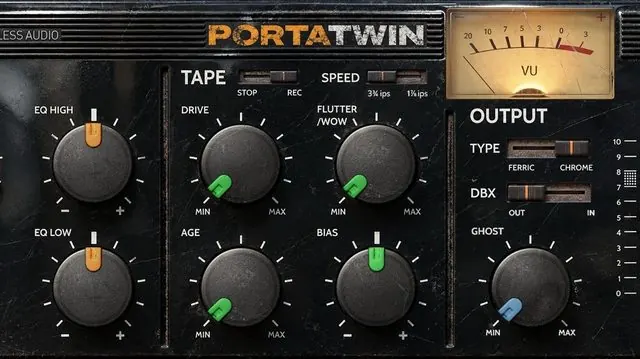
All six for €49PortaTwin
Four-track, 1987
The preamp clips early. The tape wears out. We kept both.
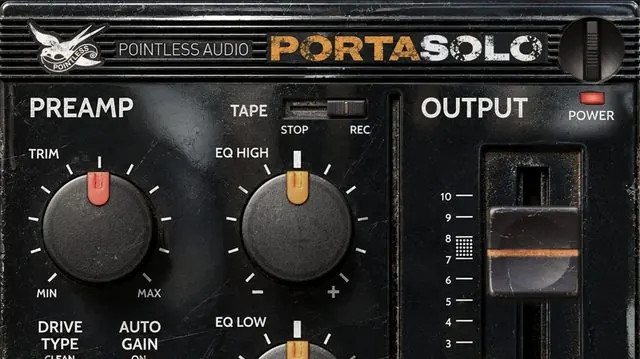
€29BuyPortaSolo
One channel of PortaTwin
One channel. The tape, set once. Free.
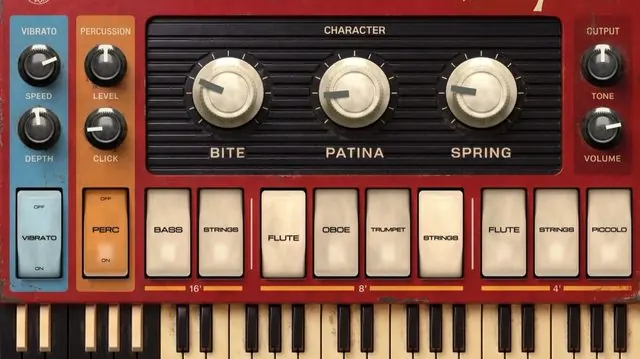
FreeDownloadCompatto
Combo organ, 1960s
We modeled the organ, and the sixty years since.
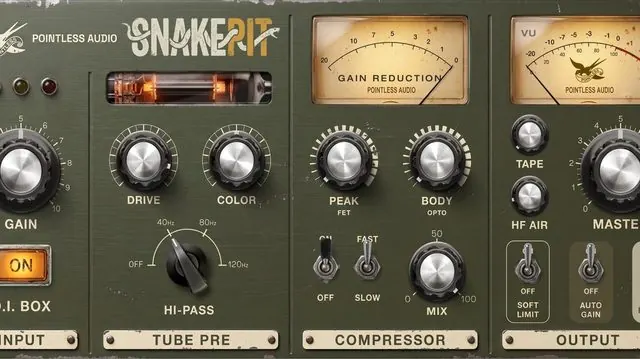
€24BuySnakePit
Tube strip, our own
Detroit-inspired channel strip, from the DI to the output transformer.
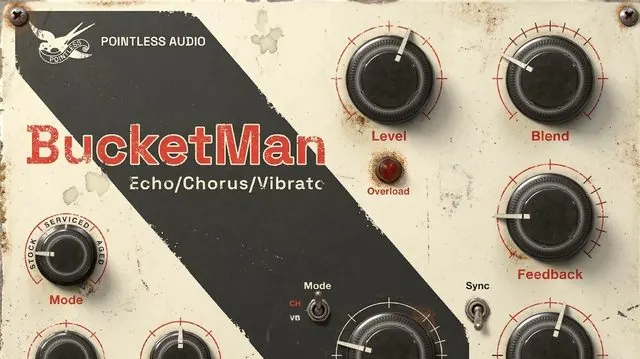
€24BuyBucketMan
BBD pedal, 1980
Bucket-brigade delay and chorus, from soft repeats to runaway feedback.
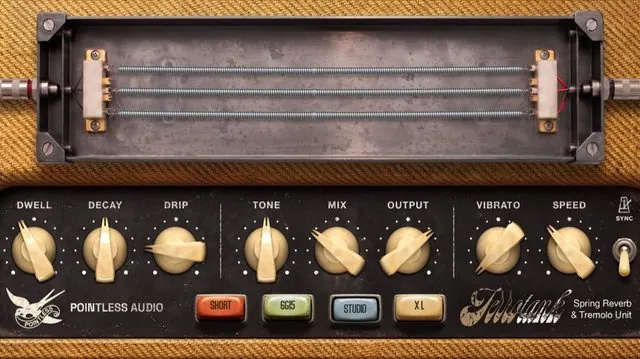
€19BuyFerrotank
Spring tank, 1961
Strike, pluck or damp the springs, or play them from a MIDI key. The drip is the point.
€19Buy