Pointless Audio / Plugins / Ferrotank
Spring Reverb · Spring tank, 1961
Ferrotank
Brighter than faithful. The real pickup rolls off the surf; ours doesn’t.
Strike, pluck or damp the springs with the mouse, or play them from a MIDI key. Behind them, the whole tube circuit that defined surf guitar. The drip is the point.
- Machine
- A 1961 tube spring reverb tank
- Version
- v1.0.0
- Runs on
- VST3 · AU · CLAP — macOS, Windows, Linux
- License
- Pay once. No iLok, no account, no subscription
Or all six for €49, Ferrotank included. Get all six · Money back in 14 days if it doesn’t run on your system.
4.9 from 50 ratings on Gumroad

What people say
Some reverbs create JUSTwidth, but this one creates width AND depth, in buckets! - I absolutely love it and will be using it as often as I can.
Love that you can mess with the strings!
Hear it
The same take twice, level-matched. Switch the plugin off and on while it plays.
Keys
Rhodes in the spring
Every chord leaves a spring tail, with a metallic sparkle on the attacks. With bass and drums, the Rhodes moves back and takes space.
Keys
Celesta in the spring
The notes end in a dark, slightly trembling spring tail. In the track, the celesta stays on top with space behind it.
Guitar
Guitar with tremolo, in the spring
The guitar on its own: the sound pulses with the tremolo and every note leaves a spring tail; the hard attacks set off the DRIP.
What it does
Play the springs
The spring tank on the panel is playable. A quick click strikes a spring, as hard as you move. Press, pull and let go to pluck it. Hold it to rest a hand on it and damp the tail. Click the frame and you knock the whole tank.
From a MIDI key
Pick a MIDI device in the new MIDI panel and play the springs from a key or a pad, with true velocity: the plugin reads the device itself, no routing in the DAW. Fast repeats scrape the spring, a chord knocks the tank, the sustain pedal rests a hand on it.
The whole tube circuit
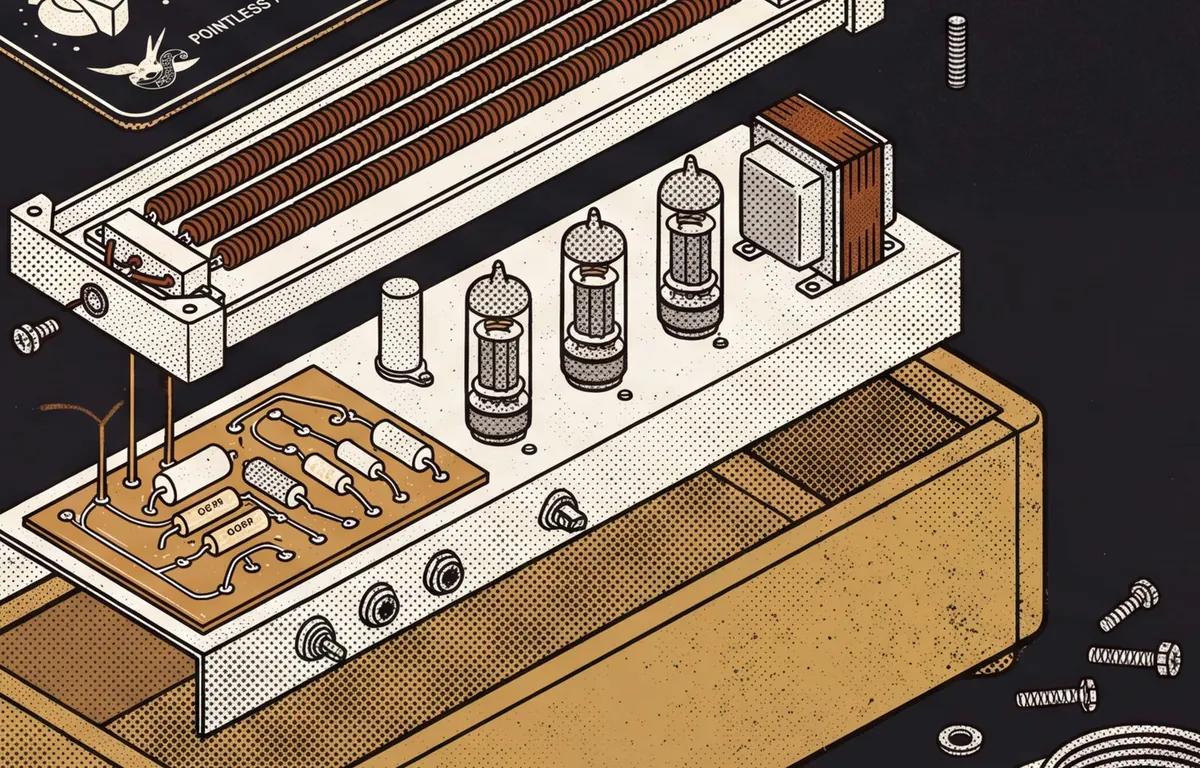
Not an impulse response, not a hall algorithm. A model of the whole tank: a tube preamp that drives the springs, the springs with their unmistakable chirp, and a vintage bias-style tremolo on the way out.
DWELL, DRIP, DECAY
DRIP takes it from a soft, warm wash to a full surf drip — on every tank. DWELL works like the original pot, from silence to a driven tank. Hit it hard enough and it crashes — because that’s what a real spring tank does.
Four tanks
Switch TANK and the whole spring geometry changes underneath — different lengths, different resonances, different drip. Two springs in the 6G15, tuned against a real unit.
Bright by choice
Two knobs from Dick Dale to Pharoah Sanders: a subtle wash behind a clean guitar at one end, full drip-and-splash surf crash at the other. Guitars, keys, drums and synths all take to it.
The heritage
The 6G15 reverb unit (1961–1966) was a standalone, tube-driven spring reverb built to sit ahead of a guitar amp. Its own tube preamp drove a spring tank hard, producing a dripping, splashy chirp with far more character than the reverb built into the amps of the day.
That sound became one of the defining textures of early-1960s surf music — the reverb most associated with Dick Dale — and it has stayed a studio favorite for surf, garage and cinematic guitar ever since.
Ferrotank models the character of that circuit — the tube warmth, the spring chirp, the tank resonances — not any specific artist or recording. Recordings of a real tank give the first moments of a strike when you play the springs; the reverb itself is the model.
6G15 is a model designation of its original manufacturer. Pointless Audio is not affiliated with, endorsed by, or sponsored by that company. Product names are used solely to describe the hardware that inspired this plug-in.
Specs
- Formats
- VST3 + AU + CLAP
- Platforms
- macOS (Universal) + Windows 10+ (VST3 + CLAP) + Linux x86_64 (VST3 + CLAP)
- Version
- v1.0.0
- License
- Perpetual — no account, no iLok, no subscription
- Manual
- Online manual · PDF
What’s new in 0.8
For those who have it
Touch from the mouse and from MIDI: the springs answer with strength.
- Touch
- A quick click strikes a spring with a strength that follows the pointer speed. Press, pull and let go to pluck it, where you grabbed it. Hold it to damp the tail and take out the highs; pull it while held and it rises in pitch; drag sideways to rub the coils.
- Signal path
- The touch now goes through TONE, MIX, the tremolo and OUTPUT: at MIX 0 it is silent. A recording of a real tank gives the first 150 ms of a strike and feeds the modeled springs, so the tail follows TANK, DRIP and DECAY. The two-spring tanks play it in stereo.
- MIDI
- A MIDI panel on the bottom strip: a device the plugin reads itself, a channel, a touch key you can learn, and three release behaviors. Velocity is the strength of the strike; pitch bend and aftertouch bend the pitch, CC 1 sets the hand. Notes routed by the DAW are not used in this version.
- Touch parameter
- One new host parameter, Touch, for MIDI mapping or automation. It is not on the panel and is not saved with the project.
Already have Ferrotank? Same Gumroad link: download it again. Projects saved with 0.7 open with the same settings, and the sound is the same unless you use the new touch features.
How to get it
-
01
Get it on Gumroad
Checkout runs on Gumroad, which handles payment and VAT. The download link lands in your inbox.
-
02
Download the zip
Inside: VST3 + AU + CLAP builds and the manual as PDF. macOS builds are signed and notarized. Linux is a separate tar.gz.
-
03
Install, rescan, done
macOS: run the signed installer in the zip and pick your formats. Windows: copy the plugin into your plugin folder. Linux: extract the tar.gz, copy the .vst3 folder to ~/.vst3 and the .clap file to ~/.clap; README.txt inside has the steps. Rescan in your DAW. No account, no activation. The manual has the exact paths for macOS and Windows.
Questions
How do I install it?
On macOS, run the installer inside the zip: it is signed and notarized, and lets you pick the formats. On Windows, copy each format into your plugin folder. On Linux, extract the tar.gz and copy the .vst3 folder to ~/.vst3 and the .clap file to ~/.clap, as README.txt inside the package explains. Then rescan in your DAW. The manual has the exact paths for macOS and Windows; Linux is in README.txt.
Do I need an account, a dongle, or an internet connection?
No account, no iLok, no subscription, no activation. Once installed it runs fully offline.
Does it work in my DAW?
Any host that loads VST3, AU or CLAP: Logic Pro, Ableton Live, Reaper, Bitwig, Cubase, Studio One, FL Studio and friends. No AAX — Pro Tools is not supported.
Does it run on Linux?
Yes: x86_64, VST3 and CLAP, no AU. It needs glibc 2.38 or newer (Ubuntu 24.04+, Debian 13, Fedora 39+); Ubuntu 22.04 and Debian 12 are too old. The CLAP build is experimental. Same sound engine as the macOS and Windows builds. If something doesn’t load or sounds wrong, write to hello@pointlessaudio.studio.
Windows says the file is from an unknown publisher.
Windows builds are not code-signed yet, so SmartScreen may warn on first run. The zip you download from Gumroad is the zip we built — choose “Run anyway” or unblock the file in Properties.
Refunds?
If it doesn’t run on your system, you get your money back. 14 days. Write to hello@pointlessaudio.studio — most problems are quick to fix, and if yours isn’t, the refund goes through Gumroad.
Have updates been free?
So far, yes: every update has been free, delivered through the same Gumroad link.
€19
Pay once. No iLok, no account, no subscription. If it doesn’t run on your system, you get your money back. 14 days.
More machines
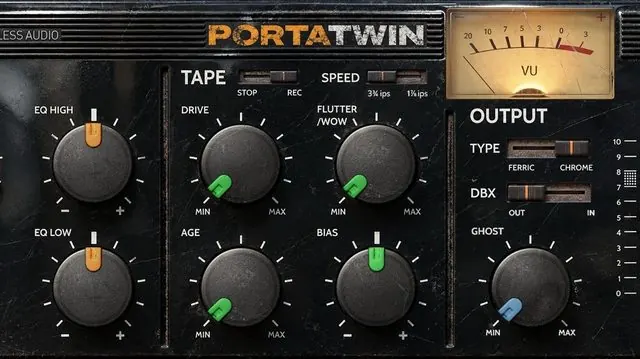
All six for €49PortaTwin
Four-track, 1987
The preamp clips early. The tape wears out. We kept both.
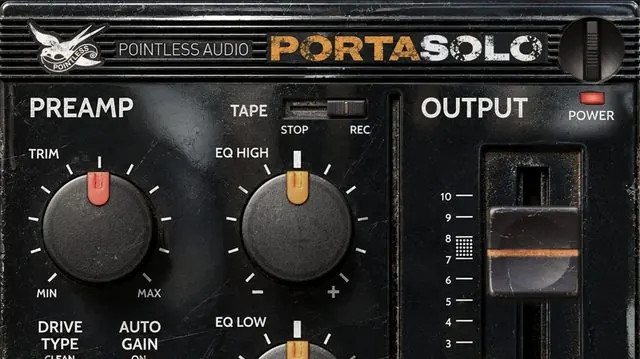
€29BuyPortaSolo
One channel of PortaTwin
One channel. The tape, set once. Free.
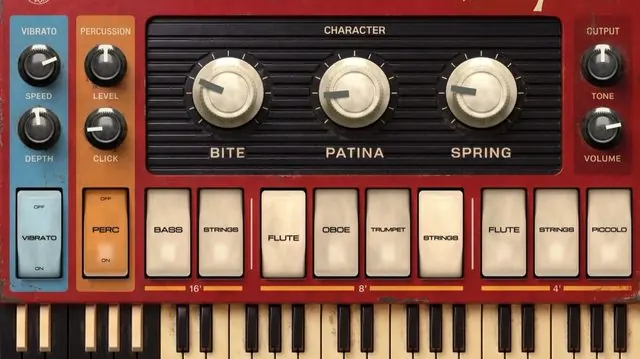
FreeDownloadCompatto
Combo organ, 1960s
We modeled the organ, and the sixty years since.
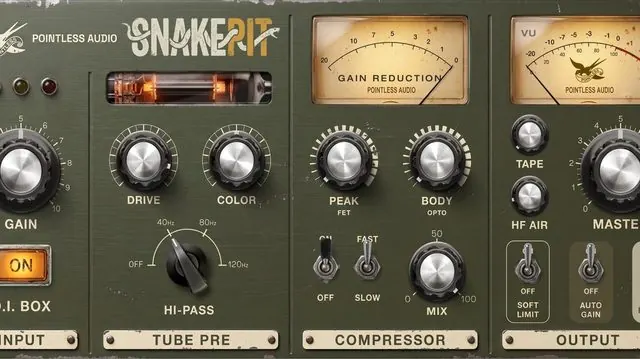
€24BuySnakePit
Tube strip, our own
Detroit-inspired channel strip, from the DI to the output transformer.
€24BuyBucketMan
BBD pedal, 1980
Bucket-brigade delay and chorus, from soft repeats to runaway feedback.
€19BuyAlphaRail
Synth preamp, 1971
The 2600’s preamp, rebuilt from the schematic. Free.
FreeDownload