BUCKETMAN
It never quite repeats what you played.
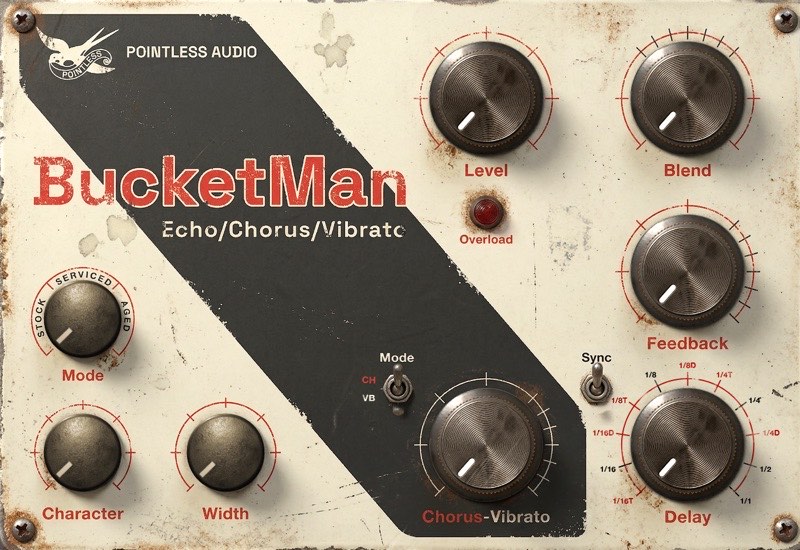
Analog BBD delay modeled after a classic delay pedal. Echo, chorus, and vibrato — dark repetitions with all the grit of bucket-brigade circuits.
- VST3 + AU + CLAP
- macOS (Universal) + Windows 10+ (VST3 + CLAP)
- Instant download via Gumroad
- macOS builds notarized by Apple
- No account. No iLok. No subscription.
Audio demos are being recorded — dry against wet, same take, no cherry-picking. The dev log hears them first.
Three hardware conditions
Stock, Serviced, Aged. Same circuit, three different lives. Aged is not for the faint of heart.
Bandwidth that collapses
High end rolls off as delay times grow — tracking the clock frequency, exactly like the bucket-brigade chips did. The repeats darken because they have to.
A compander that breathes
The noise-reduction stage compresses before the delay line and expands after it, coloring everything on the way through. And a feedback path that will happily run away into self-oscillation if you let it.
LEVEL like the original pot
It rides both the preamp and the master out, the way the hardware control did: drive it hard, or kill a runaway mid-flight.
Slow internal modulation
A Wien bridge LFO with rates measured on the original pedal — liquid chorus at 0.50 Hz, vibrato at 0.60 Hz, tempo sync with 11 subdivisions.
Where it works
Guitars, obviously. But also synth lines, vocal throws, drum sends — anywhere a digital delay would be too polite. 12 presets, from tight slapback to Broken Unit.
Designed in 1976 by Howard Davis, the original pedal defined what an analog delay could sound like. Its bucket-brigade delay line, companding noise reduction and slow internal modulation created a sound no digital algorithm has fully captured.
Records made with it run through four decades of guitar history: U2’s Boy and Where the Streets Have No Name, the textures of Radiohead — Ed O’Brien calls his unit the “god pedal” — and the work of J Mascis with Dinosaur Jr.
BucketMan models the full signal chain: bucket brigade, compander, LFO, and the aging instabilities that make every surviving unit slightly different. It never quite repeats what you played. That’s the point.
- Formats
- VST3 + AU + CLAP
- Platforms
- macOS (Universal) + Windows 10+ (VST3 + CLAP)
- Version
- v1.2.28
- License
- Perpetual — no account, no iLok, no subscription
- Manual
- Online manual · PDF
- Price
- Free / Pay What You Want
-
01
Get it on Gumroad
Checkout runs on Gumroad — card or PayPal. Pay what you want, including zero. The download link lands in your inbox.
-
02
Download the zip
Inside: VST3 + AU + CLAP builds and the manual as PDF. macOS builds are notarized — no Gatekeeper drama.
-
03
Copy, rescan, done
Drop the plugin into your plugin folder, rescan in your DAW. No installer, no account, no activation. The manual has the exact paths.
How do I install it?
Download the zip, copy each format into your plugin folder, rescan in your DAW. The manual walks through the exact paths for macOS and Windows.
Do I need an account, a dongle, or an internet connection?
No account, no iLok, no subscription, no activation. Once installed it runs fully offline, forever.
Does it work in my DAW?
Any host that loads VST3 + AU + CLAP: Logic Pro, Ableton Live, Reaper, Bitwig, Cubase, Studio One, FL Studio and friends. No AAX — Pro Tools is not supported.
Windows says the file is from an unknown publisher.
Windows builds are not code-signed yet, so SmartScreen may warn on first run. The zip you download from Gumroad is the zip we built — choose “Run anyway” or unblock the file in Properties.
Refunds?
Payments run through Gumroad, refunds follow Gumroad’s policy. If something is broken, write to hello@pointlessaudio.studio first — most problems are a five-minute fix.
Are updates free?
Yes — free updates within the current major version, delivered through the same Gumroad link.