PORTATWIN
The preamp clips early. That's the point.
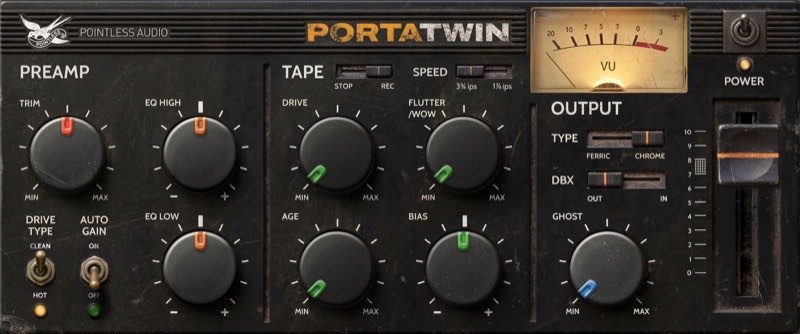
Cassette channel strip modeled after a 1987 four-track portastudio. Preamp saturation, tape wow & flutter, hiss, and the warmth of a machine that was never meant to be perfect.
- VST3 + AU + CLAP
- macOS (Universal) + Windows 10+ (VST3 + CLAP)
- Instant download via Gumroad
- macOS builds notarized by Apple
- No account. No iLok. No subscription.
Audio demos are being recorded — dry against wet, same take, no cherry-picking. The dev log hears them first.
A preamp that clips early
And unapologetically. From clean analog coloring to full tape destruction — the input stage colors everything it touches, exactly like the machine it comes from.
Tape that drifts
Wow, flutter, and a BIAS control you can push until the top end gives up. The transport wobbles because the original transport wobbled.
Companding that breathes
dbx-style noise reduction that pumps and breathes the way the hardware did. It was built to tame the hiss; it ended up shaping the sound.
The parts others leave out
Channel crosstalk and the 65–110 Hz head bump — the corners of the machine most emulations politely skip. v1.7 keeps them in.
Where it works
Drum bus, synths, guitars, full mixes when you’re feeling brave. Not the most accurate “studio tape” plugin — the one that makes a demo sound like a record you found in a drawer.
16 parameters, 14 presets
Everything automatable. Presets from subtle analog glue to full lo-fi collapse.
Introduced in 1979, the Portastudio was the first portable four-track cassette recorder — it put a recording studio in a bedroom. The machines that followed defined an era of independent music made outside professional studios.
Records made on that family of machines include Bruce Springsteen’s Nebraska (1982, recorded on a 144), the Oasis demos for Definitely Maybe, Mac DeMarco’s Rock and Roll Night Club, John Frusciante’s first solo albums, and the catalogues of Ween, Iron and Wine, and Elliott Smith.
PortaTwin models one machine from that family — a 1987 four-track — preamp, tape, transport, and noise reduction. The character that made the bedroom four-track its own production aesthetic.
- Formats
- VST3 + AU + CLAP
- Platforms
- macOS (Universal) + Windows 10+ (VST3 + CLAP)
- Version
- v1.8.0
- License
- Perpetual — no account, no iLok, no subscription
- Manual
- Online manual · PDF
- Price
- Free / Pay What You Want
-
01
Get it on Gumroad
Checkout runs on Gumroad — card or PayPal. Pay what you want, including zero. The download link lands in your inbox.
-
02
Download the zip
Inside: VST3 + AU + CLAP builds and the manual as PDF. macOS builds are notarized — no Gatekeeper drama.
-
03
Copy, rescan, done
Drop the plugin into your plugin folder, rescan in your DAW. No installer, no account, no activation. The manual has the exact paths.
How do I install it?
Download the zip, copy each format into your plugin folder, rescan in your DAW. The manual walks through the exact paths for macOS and Windows.
Do I need an account, a dongle, or an internet connection?
No account, no iLok, no subscription, no activation. Once installed it runs fully offline, forever.
Does it work in my DAW?
Any host that loads VST3 + AU + CLAP: Logic Pro, Ableton Live, Reaper, Bitwig, Cubase, Studio One, FL Studio and friends. No AAX — Pro Tools is not supported.
Windows says the file is from an unknown publisher.
Windows builds are not code-signed yet, so SmartScreen may warn on first run. The zip you download from Gumroad is the zip we built — choose “Run anyway” or unblock the file in Properties.
Refunds?
Payments run through Gumroad, refunds follow Gumroad’s policy. If something is broken, write to hello@pointlessaudio.studio first — most problems are a five-minute fix.
Are updates free?
Yes — free updates within the current major version, delivered through the same Gumroad link.