SNAKEPIT
Manual
v1.4.1 · VST3 + AU + CLAP · macOS (Universal) + Windows 10+ (VST3 + CLAP)
What it does
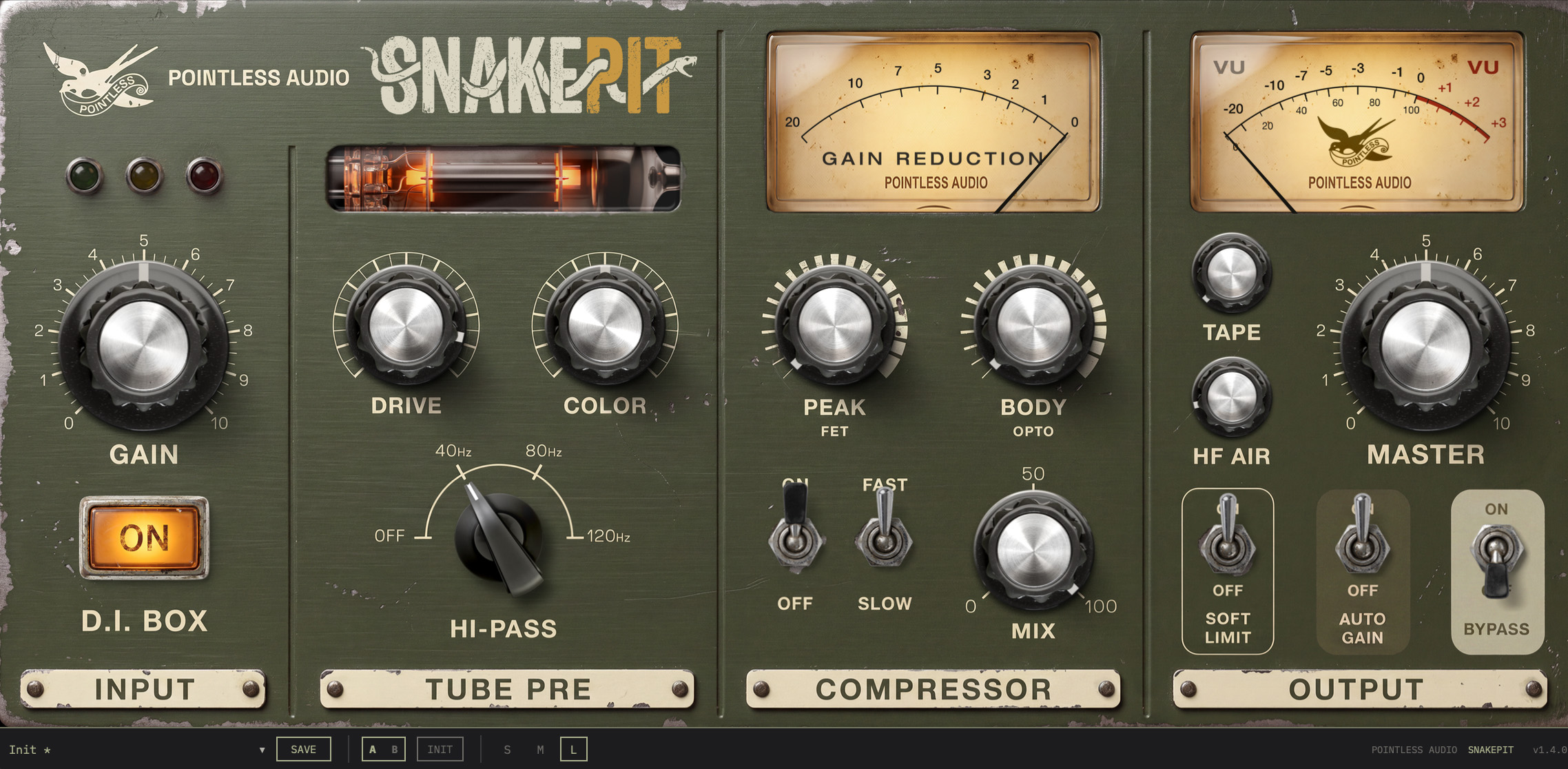
SnakePit is a tube channel strip: one input channel of a console that never existed, built around a single valve. Put it on a track, set the input level with the three lamps, and decide how much character it adds — from "this went through real hardware" clean, through warm and dense, to openly saturated.
The valve is where the character comes from. It's a physical model of a triode — an original design, not an emulation of one specific unit — and the rest of the chain exists to serve it: put the right level in front of it, catch what comes out the other side. In front sit an iron DI stage you can switch off and a high-pass; after it, two compressors in series — PEAK fast for grip, BODY slow for weight — then a tape polish, an air shelf, an output transformer, and a safety limiter on the way out.
AUTO GAIN keeps the loudness anchored while you do all this, so every control is a tone decision: turn DRIVE up and the sound gets denser and rounder, not louder. That's what makes the plugin quick to use — you can push hard and trust that what you're hearing is character, not level.
It is not an amp sim, not a cabinet sim, and not four machines in one — it sounds like one machine, and the controls change how hard you push it. It was born around a bass DI, and bass is still the thing it does best: the gentle low-end rise of the output transformer is most of why a bass sits in a mix instead of just getting louder. But the valve doesn't care what you feed it — drums, voice, brass, synths and a full mix all work, and the DI colour is a switch, not the point.
Start here: the three lamps
Everything in SnakePit depends on hitting the valve at the right level, so the first thing to learn is the row of three lamps above GAIN.
- Green — signal is arriving.
- Yellow — you are in the right place. This is the level the whole plugin was
voiced at.
- Red — a peak just went over. On drums and other spiky sources it will flash
now and then even at the right level — that's normal. Steady red means come down.
Green and yellow light up in order and stay lit as you go up. Red watches the peaks, so on spiky material it can flash before yellow has even settled. Yellow on, with red dark or only flickering, means the input level is right — a drum bus at the right level will still flash red on the hits, and that's the lamp doing its job, not a problem to fix.
Set GAIN so yellow is on and red is dark or only flickering, then forget it and use the rest of the plugin. If you are feeding a modern master that already sits loud, you will need to bring GAIN down, not up, to find yellow.
If your source is very quiet, GAIN may not have enough range on its own — put some gain in front of SnakePit in your DAW and then set the lamps.
Parameters
Sixteen controls across the four panel sections — INPUT, TUBE PRE, COMPRESSOR and OUTPUT. All of them are automatable. Where the panel name and the host automation name differ, the automation name is in brackets.
| Parameter | Range | Default | What it does |
|---|---|---|---|
| GAIN (Input) | 0–10 dial · ±20 dB | 5 (unity) | Drives the valve — with AUTO GAIN on it changes tone, not loudness |
| D.I. BOX (DI) | on / off | on | Front-end colour: weight down low, a little presence on top |
| HI-PASS (Low Cut) | Off / 40 / 80 / 120 | Off | High-pass ahead of the valve — protects as well as tidies |
| DRIVE | 0–100% | 28% | How hard the valve is pushed |
| COLOR | 0–100% | 50% | Tone of the whole machine, dark to bright |
| PEAK | 0–100% | 0% | The fast compressor — grip on the transients |
| BODY | 0–100% | 0% | The slow compressor — weight on the sustain |
| MIX (Comp Mix) | 0–100% | 100% | Parallel blend of the compressed signal |
| COMP ON | on / off | on | Takes the compressor out, keeps the knobs |
| FAST / SLOW (Comp Fast) | toggle | FAST | Release of the slow compressor |
| TAPE | 0–100% | 0% | A polish, not an effect |
| HF AIR | 0–100% | 12% | A shelf that opens the top end |
| MASTER (Output) | 0–10 dial · ±20 dB | 5 (unity) | Sets the level — past a point the limiter does the work |
| SOFT LIMIT (Limiter) | on / off | on | Safety ceiling on the output |
| AUTO GAIN | on / off | on | Keeps loudness anchored while you shape the tone |
| BYPASS | on / off | off | The whole plugin out, timing-matched |
GAIN and MASTER
Both dials are marked 0 to 10. That's a scale, not decibels — the parameters underneath run ±20 dB, so 5 is unity and either end is twenty decibels away. They have different jobs and it's worth knowing which.
GAIN pushes the valve. With AUTO GAIN on it barely changes how loud the plugin is — it changes how hard the valve is working. That's the point: you drive with GAIN and the output stays where you put it.
MASTER sets the level and doesn't push anything. It's clean for about fourteen decibels above the default working point; past that the limiter starts doing the work and the amber wedge on the output meter lights up to tell you it's happening. It will keep getting louder, but you're listening to the limiter, not the valve.
(The panel says GAIN and MASTER; the host automation parameters are Input and Output.)
HI-PASS — Off / 40 / 80 / 120
A high-pass at the very front, before the valve, so it protects as well as tidies.
- Off — nothing is cut. A five-string keeps its low B.
- 40 — stage rumble and handling noise, without touching the bottom string.
- 80 — the classic DI voicing. Tightens a bass, keeps the body.
- 120 — for voice and guitar: plosives, proximity boom, and the rumble under
the low string.
The three numbers are the filter's own corners. Where you actually hear the cut also depends on where COLOR is sitting, because both work on the same low end — so trust your ears over the number, and pick the position that sounds right rather than the one that matches a frequency you had in mind.
(The panel says HI-PASS; the host automation parameter is Low Cut.)
DI BOX
The front-end colour: a lift in the low end and a little presence on top. It's what makes a DI'd bass sound like it went through something instead of straight into the converter.
On bass and drums it's about a decibel and a half of extra weight down low, and that's where it earns its place. On a voice it also softens the presence band a touch — the consonants — which is why the Vocal factory preset leaves it out. Turn it off if you want the source back plain.
(The panel says D.I. BOX; the host automation parameter is DI — on means in.)
DRIVE
How hard the valve is pushed. Low is warm and mostly clean; as you go up the transients start to round off and the harmonics come forward. Past about the three-quarter mark you're in saturation on purpose — the flattening of the transients is the effect at that point, not a mistake.
COLOR
The tone of the whole machine, dark to bright. Turn it down and the low end fills out and the top softens; turn it up and it opens and thins. It moves more level than any other control here, so use your ears rather than expecting it to stay put.
PEAK, BODY, MIX, COMP ON — the compressor
Two compressors, one after the other. PEAK is the fast one: it catches transients and adds grip. BODY is the slow one: it leans on the sustained part and adds weight. Both knobs set how much, never how fast.
Two things to know, because they aren't obvious:
They are in series, and the fast one goes first. BODY works on whatever PEAK leaves behind. Push PEAK up past three-quarters and BODY has nothing left to grab — it will look like the knob has stopped working, and effectively it has. If you want the slow compressor's character, keep PEAK low.
Both need level to bite. Their thresholds are fixed, so how far you have to turn them depends on how hard you're going in. At the calibration level — yellow lamp on — BODY starts working around a third of the way up. Feed it five decibels quieter and it will feel dead until halfway. If a knob feels inert, look at the lamps first.
MIX blends the compressed signal back against the untouched one, for parallel compression. The gain-reduction meter follows what you actually hear, so as you bring MIX down the needle comes down with it.
COMP ON takes the compressor out without losing where PEAK and BODY are set — it's there for A/B, not for tone.
FAST / SLOW
The release of the slow compressor. FAST is the default and is how the plugin has always behaved. SLOW holds on longer — up to about five decibels more tail on a sustained note. It's the one switch here that clearly changes the sound.
TAPE and HF AIR
TAPE is a polish, not an effect: a gentle squeeze and a softening of the very top, the way a machine flatters a mix without announcing itself. HF AIR is a shelf that opens the top end. Both are subtle by design.
AUTO GAIN
On by default, and it's the reason the plugin doesn't get louder every time you turn something up. It compensates the level the character stages add, so an A/B against bypass is a comparison of tone, not of volume.
Turn it off if you want to hear the raw gain structure. COLOR is not compensated — it's a tilt, and its level shift is the tone change. Everything else is, DI BOX included: engaging the DI changes the sound, not the loudness.
SOFT LIMIT
A safety ceiling on the output, on by default. With it off the plugin can go past full scale — that's your choice to make, and your DAW's problem to catch.
It reacts rather than predicts: on a sudden loud front — a downbeat, the first hit after silence — the very first swing can slip past the ceiling before the clamp takes hold. If a bounce must stay under full scale no matter what, put a proper limiter at the end of the chain and treat this one as the seat belt.
(The panel says SOFT LIMIT; the host automation parameter is Limiter.)
BYPASS
Bypasses the whole plugin, and the dry signal is delayed to match — so switching back and forth compares the sound and not the timing.
Factory presets
Eight starting points. None of them touches GAIN or MASTER: the input level is yours, set with the lamps — that's the first gesture of the plugin, and a preset that fought it would be wrong on any source but its own.
| Preset | What it's for |
|---|---|
| Init | The plugin's own defaults. |
| Clean Lift | A touch of valve and nothing else — DI out, compressor still, no tape. The point of departure for hearing what everything else does. |
| Warm Glue | Mix bus. Gentle compression from both stages kept low, DI out, a little tape and air. |
| Bass DI | The house specialty. Weight from the slow compressor, cut left off so a four- or five-string keeps its fundamentals. |
| Bass Tight | The other half of bass: articulation instead of weight. The fast compressor leads, BODY stays off, and the cut sits at the classic 80. |
| Drum Bus | Push hard and blend back — MIX at mid-travel is the point of this one, not a detail. DI in, for the extra weight down low. |
| Vocal | The optical case: BODY leads with PEAK low, the release on SLOW, the cut at 120 for plosives, DI out to keep the consonants. |
| Brass | Lots of mids and hard attacks, so the two stages share the work at mid travel. |
They're deliberately conservative: each one is a sound you refine with the two or three knobs it points you at, not a finished picture.
How it works
For the curious. You don't need any of this to use it.
The chain has one job before it has any other: put the right level in front of the valve. That's why GAIN and the lamps come first, why AUTO GAIN exists, and why the compressor sits after the valve rather than before it. The valve makes the character; the dynamics keep it in the window where it sounds good instead of competing with it.
The high-pass sits at the very front, ahead of everything non-linear. That isn't only tidiness. A very low note that reaches a valve comes back out as its own harmonics an octave or two up — you lose the fundamental and keep the buzz. Cutting before the valve means those harmonics are never made in the first place.
The low end has a gentle rise around ninety cycles and then falls away below. That shape isn't an accident and it isn't an equalizer: it's what iron does at the bottom of its range, and it's most of why a bass sits in a mix after going through this rather than just getting louder.
Design notes
- The dials say 0 to 10, not decibels. That's the console convention — 5 is
unity and either end is twenty decibels away. The lamps tell you where you are; the numbers just give you somewhere to come back to.
- The soft limit doesn't predict. No lookahead, on purpose: the latency
stays flat, and in exchange the very first swing of a sudden front can slip past the ceiling. It's a seat belt, not a mastering limiter.
- BODY lives downstream of PEAK, by design. The fast stage goes first, so
pushing PEAK past three-quarters leaves nothing for the slow one. That's not a bug to fix — it's how a chain of two compressors behaves. Keep PEAK low when you want the optical character.
- AUTO GAIN leaves COLOR alone. COLOR is a tilt, and its level shift is the
tone change itself; compensating it away would fake the comparison it exists to let you make. The DI used to be exempt for the same reason — but it ships engaged, so its level never got compared, it just made the plugin louder than its own bypass. Since v1.4.1 it's compensated like every other character stage.
- It's an original design. There is no emulation target and no captured
unit: valve-and-transformer behaviour in general, tuned by measurement and kept honest by ear.
Installation
macOS
Double-click the PA_SnakePit_macOS.pkg installer — it places the VST3, AU and CLAP in the standard system folders. Rescan in your DAW, or restart it. The plugin is signed and notarized.
Windows
Copy the PA SnakePit.vst3 folder from the zip to C:\Program Files\Common Files\VST3\, and PA SnakePit.clap to C:\Program Files\Common Files\CLAP\ if your DAW speaks CLAP. Rescan or restart. Windows binaries are not Authenticode signed — if your system objects, allow it and carry on.
No iLok, no account, no phone-home.
Troubleshooting
A knob feels like it does nothing — Look at the lamps. Most of SnakePit's controls have fixed thresholds, so they respond to how hard you're going in. Yellow on, red dark or only flickering, then try again.
BODY does nothing — Check PEAK. The two compressors are in series and the fast one goes first: with PEAK up high there is nothing left for BODY to work on. Keep PEAK low for the slow character.
It gets loud past a certain point on MASTER — That's the limiter. Watch the amber wedge on the output meter: when it's showing, MASTER is buying you loudness and not headroom.
Yellow never lights — Your source is either too quiet or too loud for GAIN's range on its own. Add or remove gain in the DAW before the plugin.
The plugin sounds louder than bypass — Check AUTO GAIN is on. If it is, the culprit is usually COLOR, which is not compensated by design.
macOS says the plugin can't be opened — The build is signed and notarized, so a normal install never asks. If you moved files around by hand and Gatekeeper objects, clear the quarantine flag:
xattr -dr com.apple.quarantine "/Library/Audio/Plug-Ins/VST3/PA SnakePit.vst3"
Windows flags the download — The Windows binaries are not Authenticode signed. SmartScreen may object once: allow it and carry on.
The plugin doesn't appear in the DAW — Rescan the plugin folders or restart the DAW; some hosts cache their plugin list aggressively.
Credits
Built with JUCE.
SnakePit is an original design inspired by the behaviour of valve and transformer circuits in general. It is not an emulation of, affiliated with, or endorsed by any manufacturer. Any names of studios, devices or companies that appear in our writing about this plugin are used only to describe a sound, and remain the property of their respective owners.
Support
Bug reports / feature requests: https://github.com/tweeedo911/PA_SnakePit/issues Web: https://pointlessaudio.studio
Pointless Audio pointlessaudio.studio
SnakePit is an original design. It is not affiliated with or endorsed by any hardware manufacturer.
© 2026 Pointless Audio · pointlessaudio.studio