COMPATTO
The Italian combo organ that aged badly. On purpose.
Reedy voices, vibrato, percussion and an onboard spring tank. Three knobs — Bite, Patina, Spring — take it from the showroom floor to a basement in 1966.
- VST3 + AU + CLAP
- macOS (Universal) + Windows 10+ (VST3 + CLAP)
- Instant download via Gumroad
- macOS builds notarized by Apple
- No account. No iLok. No subscription.
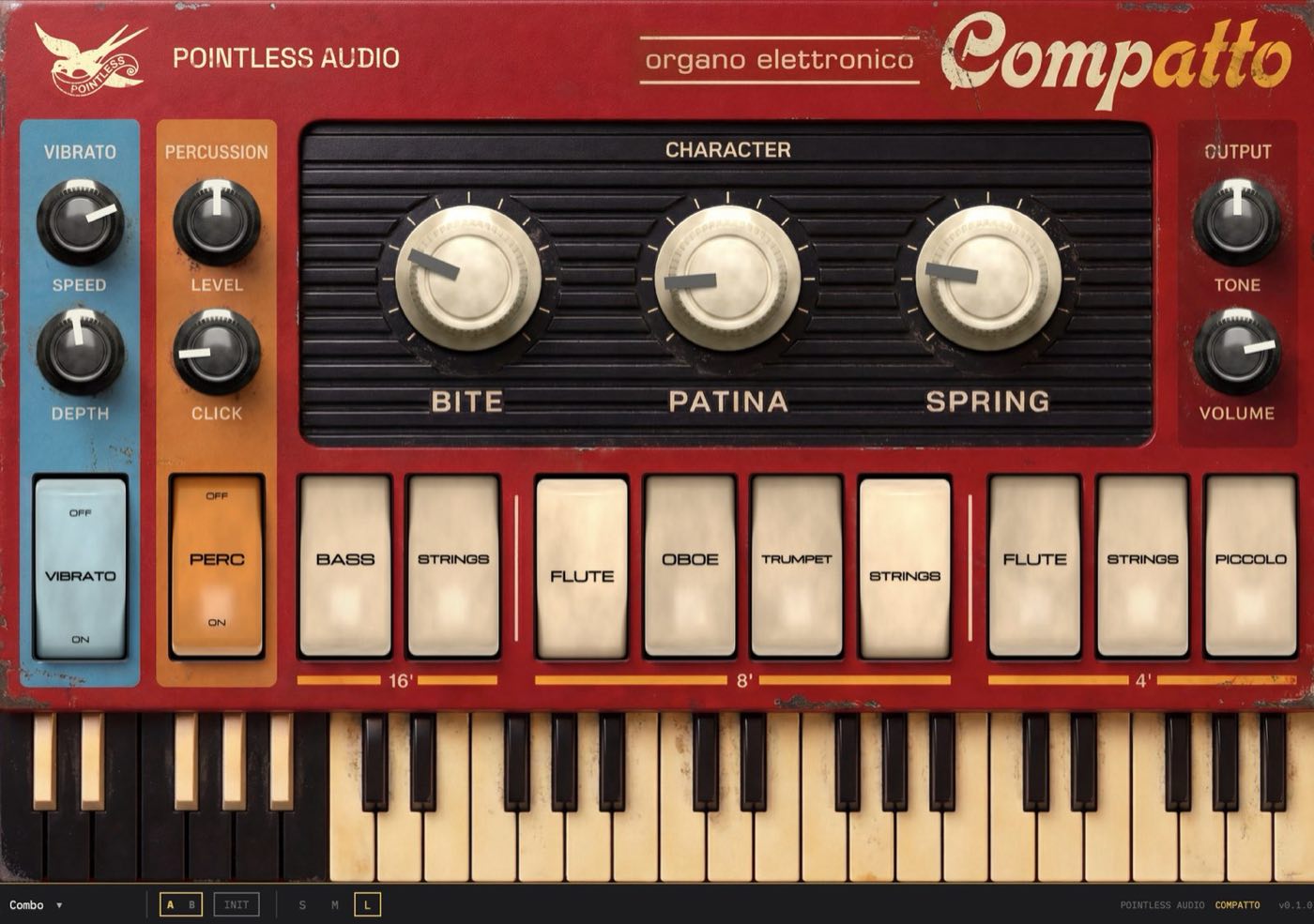
Audio demos are being recorded — dry against wet, same take, no cherry-picking. The dev log hears them first.
Nine voices, three registers
Pull the voice tabs to build a registration across 16’, 8’ and 4’ — reedy, buzzing, faintly out of tune, exactly as the divide-down circuit intended.
It plays like the real thing
A polyphonic MIDI instrument: percussion click for the attack, vibrato that soaks the whole sound, an expression input for a swell pedal.
Bite, Patina, Spring
Three CHARACTER knobs decide how much of the last sixty years the instrument carries — showroom-clean at one end, basement-worn at the other. We modeled the organ, and the sixty years since.
An onboard spring tank
The kind that came bolted into the lid — short, boingy, and exactly right behind a reedy voice.
Where it works
Sixties pop and garage, obviously. But also dub stabs, indie textures, film cues — anywhere a clean organ would be too polite.
20 parameters, 8 presets
From Combo to Basilica to Aurora — eight registrations with their own wear and their own room.
The transistor combo organ arrived in the early 1960s: compact, portable, affordable, and built down to a price. It generated its notes by dividing down a master oscillator, which is why it never quite settled in tune — and why it buzzed, clicked and shimmered in a way the church-sized instruments never did.
It turned up everywhere the money was tight and the stage was small: beat groups, garage bands, lounge acts, television variety shows. That thin, reedy, vibrato-soaked tone became a signature of 1960s pop and garage rock — and, later, of anyone chasing a warm, worn, slightly wrong sound.
Compatto models the character of that instrument — the divide-down voices, the vibrato, the percussive key click, the onboard spring — and adds the wear the years put on it. It isn’t a copy of any one make or model. It’s the sound of the class. Built to be cheap. Impossible to kill.
- Formats
- VST3 + AU + CLAP
- Platforms
- macOS (Universal) + Windows 10+ (VST3 + CLAP)
- Version
- v1.2.1
- License
- Perpetual — no account, no iLok, no subscription
- Manual
- Online manual · PDF
- Price
- Free / Pay What You Want
-
01
Get it on Gumroad
Checkout runs on Gumroad — card or PayPal. Pay what you want, including zero. The download link lands in your inbox.
-
02
Download the zip
Inside: VST3 + AU + CLAP builds and the manual as PDF. macOS builds are notarized — no Gatekeeper drama.
-
03
Copy, rescan, done
Drop the plugin into your plugin folder, rescan in your DAW. No installer, no account, no activation. The manual has the exact paths.
How do I install it?
Download the zip, copy each format into your plugin folder, rescan in your DAW. The manual walks through the exact paths for macOS and Windows.
Do I need an account, a dongle, or an internet connection?
No account, no iLok, no subscription, no activation. Once installed it runs fully offline, forever.
Does it work in my DAW?
Any host that loads VST3 + AU + CLAP: Logic Pro, Ableton Live, Reaper, Bitwig, Cubase, Studio One, FL Studio and friends. No AAX — Pro Tools is not supported.
Windows says the file is from an unknown publisher.
Windows builds are not code-signed yet, so SmartScreen may warn on first run. The zip you download from Gumroad is the zip we built — choose “Run anyway” or unblock the file in Properties.
Refunds?
Payments run through Gumroad, refunds follow Gumroad’s policy. If something is broken, write to hello@pointlessaudio.studio first — most problems are a five-minute fix.
Are updates free?
Yes — free updates within the current major version, delivered through the same Gumroad link.