PORTATWIN
Manual
v1.8.0 · VST3 + AU + CLAP · macOS (Universal) + Windows 10+ (VST3 + CLAP)
What it does
PortaTwin is a faithful emulation of the Tascam Porta Two Ministudio — the 4-track cassette recorder released in 1987. Compact, affordable, and gloriously imperfect, it defined the sound of countless bedroom recordings. Its preamp clipped early and unapologetically, its transport wobbled, and its tape hissed. That's the point.
PortaTwin captures its full signal chain: the way the preamp colors and saturates, the wow and flutter of an aging transport, the hiss and bandwidth loss of worn tape, and the noise reduction that tried to tame it all. It works as subtle analog glue or as a full lo-fi destruction unit. Everything in between is fair game.
The Tascam Portastudio legacy
Introduced by Tascam in 1979, the Portastudio was the first portable 4-track cassette home recorder — it put a recording studio in a bedroom. The family of machines that followed (Porta Two, 244, 246, 414, 424) defined an era of independent music made outside professional studios.
Records made on the Portastudio family include Bruce Springsteen's Nebraska (1982, recorded on a 144), Oasis demos for Definitely Maybe (Noel Gallagher's 246 — visible on the Supersonic sleeve, 1994), Mac DeMarco's Rock and Roll Night Club (244, 2012), John Frusciante's first two solo albums (424), and the catalogues of Ween, Iron and Wine, and Elliott Smith.
PortaTwin models the Porta Two specifically — preamp, tape, transport, noise reduction. The character that made the bedroom 4-track its own production aesthetic.
Parameters
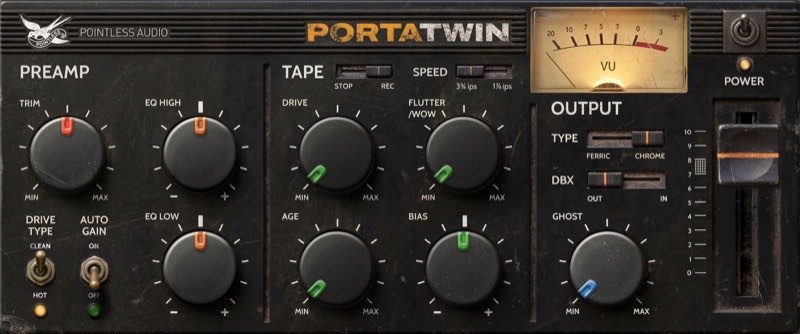
PortaTwin has sixteen controls across three sections: a preamp that colours the front end, a tape section that does most of the character, and an output stage. All of them are automatable.
PREAMP
| Parameter | Range | Default | What it does |
|---|---|---|---|
| INPUT | 0–1 | 0.5 | Front-end gain, unity at centre — how hard you push the preamp |
| EQ LOW | 0–1 | 0.5 | Low shelf — add weight or trim the bottom end |
| EQ HIGH | 0–1 | 0.5 | High shelf — open up the top or tame it |
| CLEAN / HOT | toggle | CLEAN | Preamp character. Each mode remembers its own INPUT position |
CLEAN — transparent gain with tone shaping and a gentle roll off the very top, the way the mixer stage colours a signal without obviously distorting it. Good for subtle work where the tape section does the heavy lifting.
HOT — the preamp overdriven. This is where the Porta Two's early, unapologetic clipping lives: push INPUT and the signal saturates, and because the tone controls sit between the drive stages, boosting the low shelf feeds the distortion directly. The harder you push, the more the EQ and the saturation colour each other.
TAPE
| Parameter | Range | Default | What it does |
|---|---|---|---|
| DRIVE | 0–1 | 0.0 | Tape saturation — warmth and soft compression, up to hard tape limiting |
| FLUTTER | 0–1 | 0.0 | Pitch wobble from an unsteady transport |
| AGE | 0–1 | 0.0 | Overall tape wear — hiss, lost highs, dropouts, extra saturation |
| BIAS | 0–1 | 0.5 | Shifts the saturation colour — warmer above centre, edgier below |
| SPEED | toggle | 3¾ips | Tape speed. The slower speed is noisier, narrower, more wow |
| TYPE | toggle | II | Tape formulation — Type I (ferric) or Type II (chrome) |
| TAPE IN | toggle | on | Switches the whole tape section in or out |
| DBX | toggle | off | Noise reduction — pulls the hiss down when the signal is quiet |
DRIVE — how hard you hit the tape. Low settings add warmth and a gentle squeeze; high settings soft-limit the way real tape does and bloom the low end. It glides in smoothly when you automate it, with no zipper noise.
FLUTTER — the sound of an unsteady transport: slow wow underneath, faster flutter on top, and a slow random drift. Subtle at low settings, seasick at the top.
AGE — one knob for tape wear. It stays out of the way for the first part of its travel, then brings in hiss, rolls off the highs, boosts the saturation and starts dropping out — from a slightly tired tape to a badly worn one.
BIAS — the tape's operating point. Centre is neutral; above centre leans warm and even, below centre gets edgier and grainier.
SPEED — the difference between the two cassette speeds. The slower speed narrows the bandwidth, lifts the hiss and deepens the wow — the classic long-record-time cassette sound.
TYPE — the tape formulation. Type I (ferric) is noisier and saturates earlier with a little low-end lift; Type II (chrome, what the real Porta Two used) is cleaner and wider.
TAPE IN — bypasses the entire tape section when off, leaving just the preamp.
DBX — noise reduction. It ducks the hiss when things go quiet and opens back up when the signal returns, with the faint pumping "breath" that real dbx-equipped decks had. It isn't modelled from the circuit — just tuned to feel like it.
OUTPUT
| Parameter | Range | Default | What it does |
|---|---|---|---|
| OUTPUT | 0–1 | 0.715 | Output level — unity around three-quarters up |
| GHOST | 0–1 | 0.0 | Two tape artifacts in one knob — azimuth smear, then print-through echo |
| AUTO GAIN | toggle | off | Evens out the level changes from the preamp and tape |
| BYPASS | toggle | off | Full bypass |
OUTPUT — a level trim rather than a fader: unity sits around three-quarters up, with room to boost above it and a mute only at the very bottom.
GHOST — two cassette artifacts on one control. The first half smears the stereo image the way a misaligned head does; past the middle it adds a faint pre-echo, the ghostly print-through you get when magnetic tape bleeds through to the next layer. At zero it's off.
AUTO GAIN — evens out the loudness changes the preamp and tape saturation introduce, so automating or A/B-ing stays level-matched.
VU meter — reads the level you're actually printing to tape: averaged rather than peak, with the lazy swing and slight overshoot of a real analog needle. Watch it for sustained level, not transient snaps. It rests at the bottom when bypassed.
Factory presets
| # | Preset | Character |
|---|---|---|
| 1 | Init | Clean starting point — no processing |
| 2 | Classic tape | Gentle tape color, transparent |
| 3 | Bedroom 4-track | Classic lo-fi, Type I, flutter + age |
| 4 | Cassette dub | Dub-style with flutter + ghost |
| 5 | Slow burn | Degraded tape, heavy flutter, worn oxide |
| 6 | Ghost town | Maximum azimuth + print-through |
| 7 | Vocal air | HOT warmth for vocals with subtle air |
| 8 | Drum glue | Tape compression + saturation for drum bus |
| 9 | Guitar rock | HOT mode edge for electric guitar |
| 10 | Bass fat | Low shelf boost + tape saturation for bass |
| 11 | Synth mellow | Gentle filtering and warmth for synths |
| 12 | DBX squeeze | HOT + DBX compression with auto gain |
| 13 | Tape crush | Heavy tape saturation with flutter |
| 14 | Full destruction | Everything cranked — sound design |
User presets are saved as portable .papreset files (shareable between machines and projects). Browse via the preset name in the bottom strip or with the ◀ ▶ arrows. A/B comparison via two independent state slots; COPY mirrors A onto B. Both slots persist with the DAW project.
How it works
You don't need any of this to use PortaTwin — but if you're curious what's happening to your signal:
The preamp is the front end of the machine. CLEAN keeps it transparent and just shapes the tone; HOT overdrives it into the same early, unapologetic clipping the Porta Two's mixer stage had. Because the tone controls sit between the drive stages, pushing the low shelf feeds the distortion — so the EQ and the saturation colour each other the harder you push.
The tape does most of the work. DRIVE, BIAS, TYPE and SPEED model the magnetic side — how tape soft-limits when you hit it, how the low end blooms, how the top rolls off with speed and wear. AGE ties the wear together into one knob: hiss, lost highs and dropouts. Wow and flutter come from the transport, not the tape, so FLUTTER moves independently of AGE — a machine can have a steady transport and worn tape, or the other way round.
The noise reduction chases the hiss down when the signal is quiet and lets go when it returns, complete with the faint "breathing" that gave real dbx decks their sound.
It's a model of the whole machine rather than a chain of presets, which is why pushing it too far degrades gracefully — it saturates and falls apart like tape instead of clipping like a converter.
Design notes
Ghost is not a dry/wet mix. It introduces two physical tape artifacts into the signal itself — it doesn't blend a dry copy back in. At zero, it's completely off.
Flutter and age are independent. Wow and flutter come from the transport; hiss, dropouts and lost highs come from the tape. A machine can have a perfect transport and worn-out tape, or a steady tape and a wobbly transport — so the two knobs don't track each other.
Type and speed are separate. Tape formulation and transport speed are different physical properties with different sonic effects, so they stay independent controls.
CLEAN/HOT replaces a separate drive knob. On the real Porta Two the saturation happens when you push the input, so HOT models exactly that: the harder you drive INPUT, the more it distorts.
The tone controls live inside the distortion. In HOT mode the EQ sits between the two drive stages, just as it does in the circuit, so boosting the low shelf feeds the second stage — a colour you can't get from EQ placed before or after a distortion.
Dropouts lose the highs first. On real tape the top end vanishes before the volume drops during a dropout, and PortaTwin follows that order rather than just ducking the level.
The whole chain clips softly. Nothing in the signal path hits a hard digital ceiling — it saturates and rounds over instead, so overdriving it stays musical.
Installation
macOS
Double-click the PA_PortaTwin_macOS.pkg installer and follow it — the Customize step lets you pick VST3, AU and CLAP (for Bitwig, Reaper, MultitrackStudio). Formats install system-wide to /Library/Audio/Plug-Ins/VST3/, Components/ and CLAP/. Restart your DAW.
Note: The installer is signed with an Apple Developer ID and notarized by Apple — macOS opens it directly, with no security warnings.
Windows
Copy the PA PortaTwin.vst3 folder to C:\Program Files\Common Files\VST3\.
Note: SmartScreen may warn — click "More info" → "Run anyway". Windows binary is not Authenticode signed.
Troubleshooting
VU meter looks sluggish on transients — by design. It has the weighted, slightly slow feel of a real VU meter: it reads average level, not peaks, so it deliberately lags sharp transients. Watch it for sustained level, not snaps — it's calibrated so 0 VU sits at a healthy mix level.
Plugin doesn't appear in DAW — most DAWs rescan plugins on launch. In Logic Pro: Preferences → Plug-In Manager → Reset & Rescan. In Ableton: Preferences → Plug-Ins → Rescan. In Reaper: Preferences → Plug-ins → VST → Re-scan.
State doesn't persist between sessions — verify your DAW saves plugin state in the project. PortaTwin uses APVTS standard, supported by every modern DAW.
Credits
- Inspired by the Tascam Porta Two Ministudio (1987). Tuned by ear against a real unit.
- Brand, name and visual language: Pointless Audio, 2026.
- Built with JUCE.
Support
Bug reports / feature requests: https://github.com/tweeedo911/PA_PortaTwin/issues Web: https://pointlessaudio.studio
Pointless Audio pointlessaudio.studio
PortaTwin is not affiliated with or endorsed by TEAC Corporation or the Tascam brand. Tascam, Portastudio, and Porta Two are trademarks of TEAC Corporation. This is an independent project inspired by the Tascam Porta Two Ministudio.
© 2026 Pointless Audio · pointlessaudio.studio