FERROTANK
Manual
v0.6.2 · VST3 + AU + CLAP · macOS (Universal) + Windows 10+ (VST3 + CLAP)
What it does
Ferrotank is a playable spring reverb, modelled on the 6G15 reverb unit (1961–1963) — the standalone, tube-driven tank that sat in front of an amplifier and defined the dripping, splashy reverb of early-1960s surf guitar.
It isn't an impulse response or a hall algorithm. It's a model of the whole tank: a tube preamp that drives the springs, the springs themselves with their unmistakable chirp, and a vintage bias-style tremolo on the way out. It chirps, it blooms, and if you hit it hard enough it crashes — because that's what a real spring tank does.
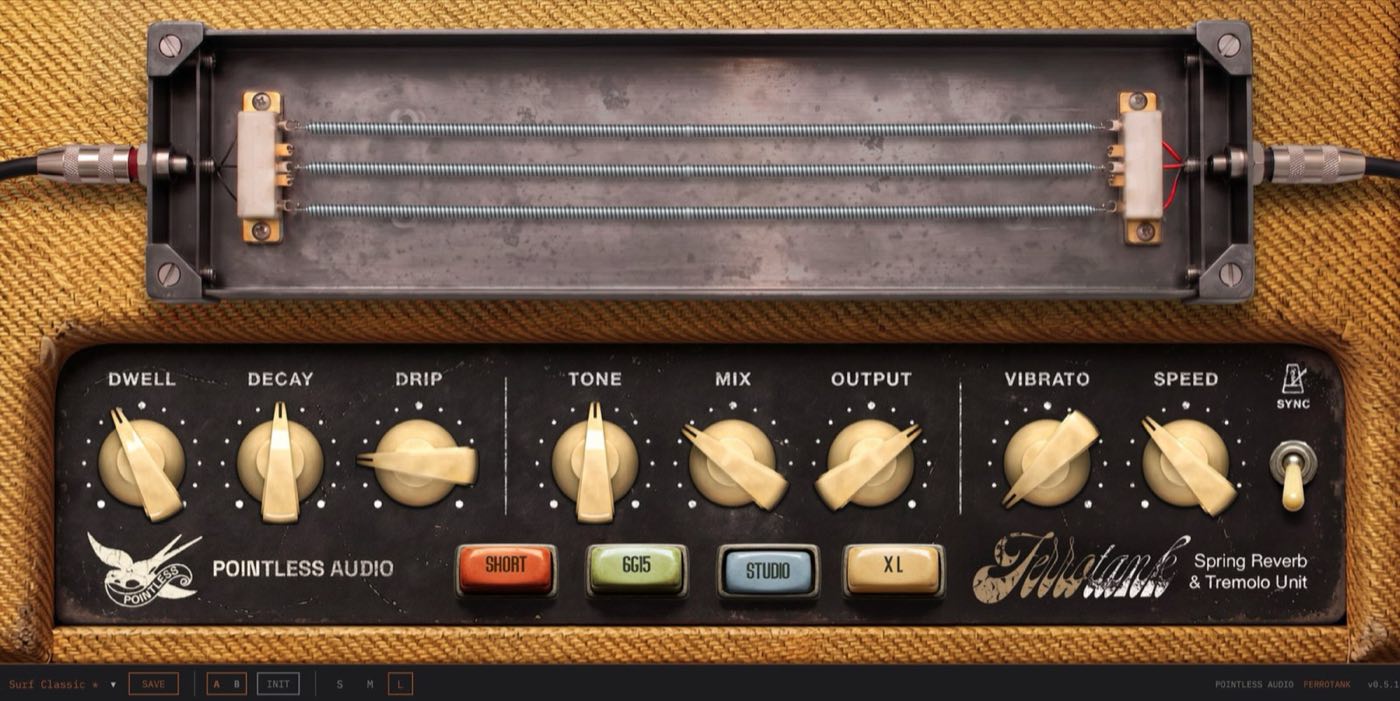
Sonically it runs from a subtle wash behind a clean guitar to a full drip-and-splash surf crash. Turn DWELL up and the tube overdrives the springs; open DRIP and the chirp stretches into a long metallic drip; switch TANK and the whole spring geometry changes underneath. Guitars, keys, drums and synths all take to it. And the spring tank on the panel is playable — click or drag the springs and they ring.
The 6G15 legacy
The 6G15 reverb unit (1961–1963) was a standalone, tube-driven spring reverb built to sit ahead of a guitar amp. Its own tube preamp drove a spring tank hard, producing a dripping, splashy chirp with far more character than the reverb built into the amps of the day.
That sound became one of the defining textures of early-1960s surf music — the reverb most associated with Dick Dale — and it has stayed a studio favourite for surf, garage and cinematic guitar ever since.
Ferrotank models the character of that circuit — the tube warmth, the spring chirp, the tank resonances — not any specific artist or recording. Real 6G15 recordings and impulse responses were used only as a tuning reference.
Parameters
Ferrotank has ten controls plus bypass. The five knobs across the top shape the reverb; the tank selector, tremolo and output trim sit below.
| Parameter | Range | Default | What it does |
|---|---|---|---|
| DWELL | 0–1 | 0.40 | How hard the tube drives the tank — clean to overdriven |
| DECAY | 0–1 | 0.50 | Reverb tail length |
| DRIP | 0–1 | 0.18 | How long and metallic the chirp is |
| TONE | 0–1 | 0.50 | Dark to bright |
| MIX | 0–1 | 0.30 | Dry / wet balance |
| TANK | Short / 6G15 / Studio / XL | 6G15 | Which spring tank |
| VIBRATO | 0–1 | 0.00 | Tremolo depth (0 = off) |
| SPEED | 0.5–12 Hz | 4.5 Hz | Tremolo rate |
| SYNC | off / on | off | Lock the tremolo to host tempo |
| OUTPUT | 0–1 | 0.70 | Output trim (unity at noon) |
| BYPASS | off / on | off | Full bypass |
The reverb
DWELL — how hard the tube preamp pushes the springs, just like the Dwell control on the real unit. Keep it low and the path stays clean and full. Past the middle the tube starts to overdrive — warm and round first, then a harder edge at the top — and it excites the tank harder, so loud transients can crash, especially with high DECAY.
DECAY — the tail. Short settings give a tight, bright, percussive reverb; open it up for a long, darker wash. As the tail gets longer the highs fade before the lows, the way a real tank behaves. The range is scaled per tank, so the physically shorter tanks stay shorter even at maximum.
DRIP — the one control with no equivalent on the original unit. It stretches and spreads the chirp: low settings are smooth and plate-like, the middle is the recognisable 6G15 boing, high settings give a long, exaggerated metallic drip for extreme surf and sound design. It changes the tank's structure rather than its level, so it glides in slowly when you move it.
TONE — a single tilt from dark to bright, flat at noon. It colours how you hear the tank rather than the springs themselves.
MIX — dry / wet balance. The dry signal always stays stereo; only the wet is summed to mono into the tank and spread back out. An internal auto-duck lets the reverb step back a touch while the source plays and bloom back on the tail, so it stays out of the way. At 100% wet (send/bus use) the tremolo acts on the reverb only.
The tank
TANK — picks one of four spring tanks. They're physically different, not tonal presets — different spring lengths, densities and decay — and they're level-matched, so switching never jumps in volume.
- Short — short, tense springs: tight, bright, punchy. Amp-style spring / rock guitar.
- 6G15 — the vintage reference. Classic surf, clean guitar, Rhodes. The default.
- Studio — longer, denser springs: a longer, darker tail.
- XL — a four-spring tank: maximum density, dark and cavernous, the longest pre-delay. Ambient and post-rock washes.
Tremolo & output
VIBRATO — tremolo depth, modelled on a vintage bias tremolo. (The panel says VIBRATO because these amps famously mislabelled the tremolo that way — we kept the label; the host automation parameter is DEPTH.) At 0 it's fully off and costs no CPU. As you raise it the modulation deepens and hardens from a gentle sway toward a firmer throb. Because it sits after the mix, it moves the dry and wet together.
SPEED — tremolo rate. With SYNC off it's a free rate; with SYNC on it snaps to musical divisions of the host tempo (1/2 down to 1/16, including triplets).
SYNC — locks SPEED to the host tempo. If the host gives no tempo, SPEED stays free.
OUTPUT — a trim on the way out, not a fader: unity sits at noon, with plenty of cut below and a little boost above. It only silences at the very bottom — for an actual mute, use BYPASS or pull MIX down.
BYPASS — full bypass with a short crossfade. Usually handled by the host.
Factory presets
| # | Preset | Tank | Character |
|---|---|---|---|
| 1 | Surf Classic | 6G15 | The reference drip. Balanced, no tremolo |
| 2 | Drip Splash | Short | Bright and splashy — high drip, driven, tight surf chirp |
| 3 | Long Wash | Studio | Longer, darker tail with a slow, shallow tremolo |
| 4 | XL Ambient | XL | Long four-spring wash, gentle tremolo, lower output |
| 5 | Tremolo Surf | 6G15 | Classic surf with a deeper bias tremolo |
Save your own as portable .papreset files, shareable between machines and projects. Browse them from the bottom strip or the ◀ ▶ arrows, compare with the two A/B slots, and return to defaults with INIT.
The spring tank on the panel is playable: click or drag the springs to pluck them. Each tank has its own original spring recording, and every strike draws a different moment of it, so repeated plucks never sound identical. The tank hears the touch too — the pluck feeds into the springs, so its bloom follows TANK, DRIP and DECAY and rides the MIX like any other signal.
How it works
You don't need any of this to use Ferrotank — but if you're curious what's under the panel:
The tube preamp is where the warmth comes from — a modelled valve stage, not a flat distortion. Low DWELL stays clean and full; push it and it overdrives the way the real 6G15 does, warm and round first, then a harder edge at the top. The lower half of the knob keeps a clean path underneath, so it never turns fizzy.
The springs are the heart of it. Instead of playing back a recording of a tank, Ferrotank models the springs directly, so the chirp — that descending metallic "drip" where the lows arrive a beat after the highs — comes out of the physics, not a sample. That's why DRIP can stretch it and why every tank sounds structurally different. It's two springs in parallel (four in the XL tank), cross-coupled like a real multi-spring tank.
The tremolo is a vintage bias-style model placed after the mix, so it breathes the dry and wet together.
No impulse responses, no algorithmic hall — it behaves like a physical tank, which is why it can chirp, bloom and crash.
Design notes
Bright by choice. The real 6G15's pickup rolls off the top hard. Ferrotank keeps its high end brighter than "faithful", because the surf brilliance is the point — only a gentle roll tames the harshest ring.
The tank stays clean. There's no synthetic hiss or hum layer. The warmth comes from the tube, the character from the springs — not from a noise floor.
DWELL is drive, not send. It sets how hard the tube pushes the springs. MIX sets how much you hear; DWELL sets what the springs get.
The tanks are physically different. Short / 6G15 / Studio / XL differ in spring length, density and decay, and are level-matched so switching doesn't jump.
The springs are playable. The tank graphic is interactive — plucking uses original per-tank spring recordings, so repeated strikes never repeat exactly, and the touch feeds the tank so it blooms in response. It's a GUI gesture, not an automatable parameter.
Installation
macOS
Double-click the PA_Ferrotank_macOS.pkg installer and follow it — the Customize step lets you pick VST3, AU and CLAP (for Bitwig, Reaper, MultitrackStudio). Formats install system-wide to /Library/Audio/Plug-Ins/VST3/, Components/ and CLAP/. Restart your DAW. All binaries are Universal (Apple Silicon + Intel).
Note: The installer is signed with an Apple Developer ID and notarized by Apple — macOS opens it directly, with no security warnings.
Windows
Copy the PA Ferrotank.vst3 folder to C:\Program Files\Common Files\VST3\.
Note: SmartScreen may warn — click "More info" → "Run anyway". The Windows binary is not signed.
Troubleshooting
Windows: SmartScreen blocks the plugin — the binary isn't signed. Click "More info" → "Run anyway". This is expected for an unsigned release.
No sound, or the reverb is too quiet — OUTPUT is a trim, not a fader, and it only silences at the very bottom. Check OUTPUT is near noon, MIX is up, and BYPASS is off. For an actual mute, use BYPASS.
Plugin doesn't appear in the DAW — most DAWs rescan on launch. Logic Pro: Preferences → Plug-In Manager → Reset & Rescan. Ableton: Preferences → Plug-Ins → Rescan. Reaper: Preferences → Plug-ins → VST → Re-scan.
State doesn't persist between sessions — check your DAW saves plugin state in the project. Ferrotank uses the standard state format supported by every modern DAW.
Credits
- Inspired by the 6G15 reverb unit. Tuned by ear against real 6G15 recordings and impulse responses.
- Spring touch samples: original recordings by Pointless Audio — one per tank (Short / 6G15 / Studio / XL) plus friction, 2026.
- Brand, name and visual language: Pointless Audio, 2026.
- Built with JUCE.
Support
Bug reports / feature requests: https://github.com/tweeedo911/PA_Ferrotank/issues Web: https://pointlessaudio.studio
Pointless Audio pointlessaudio.studio
Ferrotank is an independent project inspired by vintage 6G15-style tube spring reverb units. It is not affiliated with or endorsed by any hardware manufacturer; all product names and designations are trademarks of their respective owners.
© 2026 Pointless Audio · pointlessaudio.studio