COMPATTO
Manual
v1.2.1 · VST3 + AU + CLAP · macOS (Universal) + Windows 10+ (VST3 + CLAP)
What it does
Compatto is an electronic combo organ — the cheap, portable, faintly out-of-tune kind that filled beat groups, lounge stages and 1960s television, and whose reedy, buzzing tone outlived every serious instrument in the room.
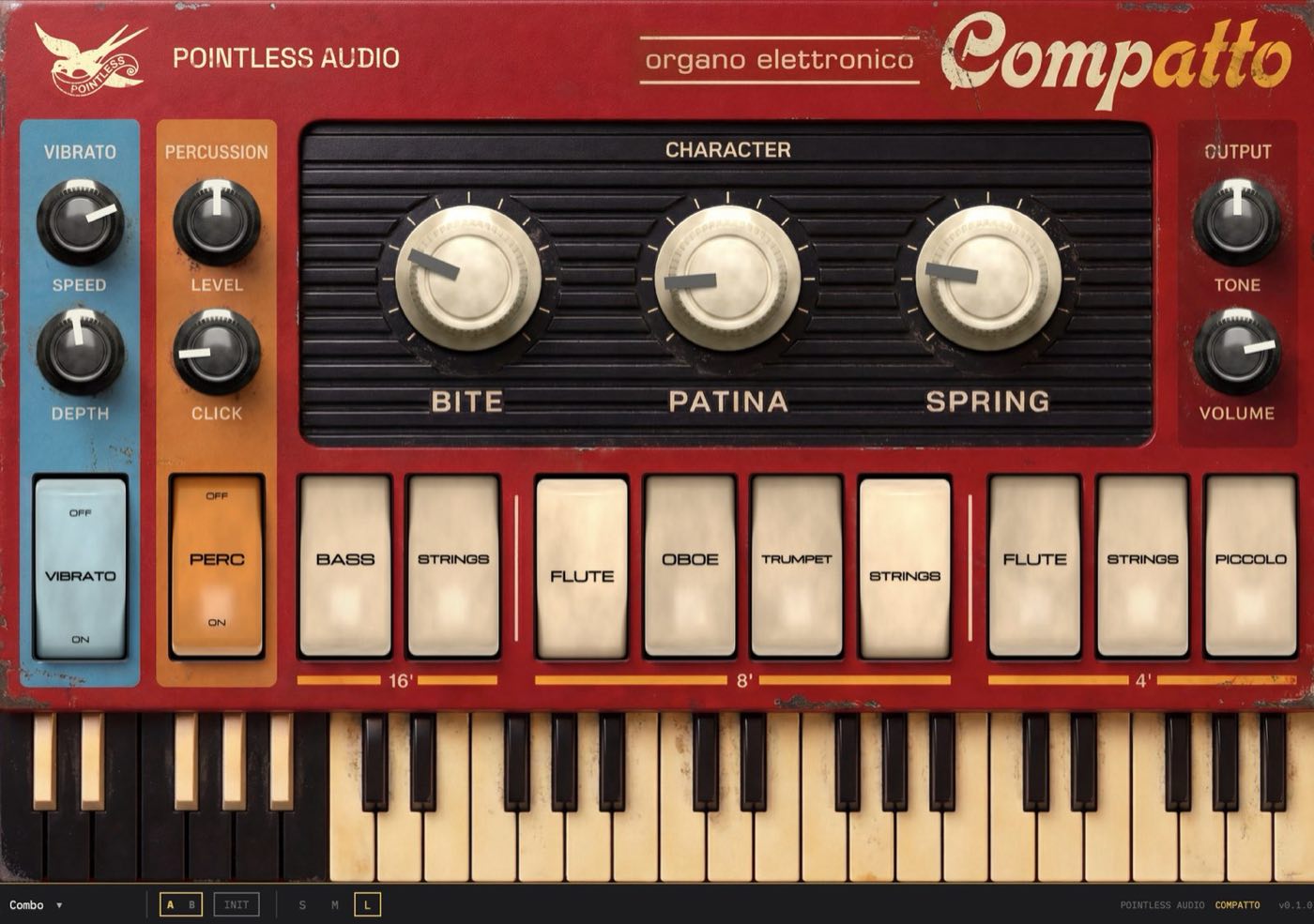
It plays like the real thing. Pull the voice tabs to build a registration, add percussion for the attack, open the vibrato, and let the onboard spring tank do the rest. Three CHARACTER knobs — Bite, Patina, Spring — decide how much of the last sixty years the instrument carries: showroom-clean at one end, basement-worn at the other.
It's a polyphonic MIDI instrument. Nine voices across three octave registers, a vibrato, a percussion click, an onboard spring reverb, and an expression input for a swell pedal.
The combo organ legacy
The transistor combo organ arrived in the early 1960s: compact, portable, affordable, and built down to a price. It generated its notes by dividing down a master oscillator, which is why it never quite settled in tune — and why it buzzed, clicked and shimmered in a way the church-sized instruments never did.
It turned up everywhere the money was tight and the stage was small: beat groups, garage bands, lounge acts, television variety shows. That thin, reedy, vibrato-soaked tone became a signature of 1960s pop, garage rock and, later, of anyone chasing a warm, worn, slightly wrong sound.
Compatto models the character of that instrument — the divide-down voices, the vibrato, the percussive key click, the onboard spring — and adds the wear the years put on it. It isn't a copy of any one make or model; it's the sound of the class.
Parameters
Compatto is played from a MIDI keyboard. The panel builds the sound: voice tabs on the bottom, character and output above.
| Section | Control | Range | Default | What it does |
|---|---|---|---|---|
| Voices 16' | Bass, Strings | on/off + level | off | Sub-octave: weight and warmth |
| Voices 8' | Flute, Oboe, Trumpet, Strings | on/off + level | Flute + Strings on | The body of the sound |
| Voices 4' | Flute, Strings, Piccolo | on/off + level | off | The bright top octave |
| voice level | −24…+6 dB | 0 dB (100%) | Hold a tab and drag to balance that voice | |
| Output | TONE | 0–1 | 0.5 | Soft and round to bright and open |
| VOLUME | −60…+12 dB | −3 dB | Master level (0 dB = unity) | |
| Vibrato | ON | on/off | on | Turns the vibrato on |
| SPEED | 0.5–10 Hz | 6.5 Hz | Vibrato rate | |
| DEPTH | 0–80 cents | 38 | Vibrato amount | |
| Character | BITE | 0–1 | 0.25 | Reed edge and growl |
| PATINA | 0–1 | 0.10 | Age, drift and wear | |
| SPRING | 0–1 | 0.20 | Onboard spring reverb | |
| Percussion | ON | on/off | off | Turns the percussive attack on |
| LEVEL | 0–1 | 0.50 | How loud the attack pops | |
| CLICK | 0–1 | 0.15 | Key-click on each note |
Voices
The nine voice tabs stack like drawbars, across three octave registers — 16' (sub-octave), 8' (body), 4' (top). Pull one for a thin, reedy lead; pull a handful for a full, buzzing registration. Each footage has its own voices: Bass and Strings at 16'; Flute, Oboe, Trumpet and Strings at 8'; Flute, Strings and Piccolo at 4'. Flute 8' and Strings 8' are on by default — a usable starting tone.
Setting the balance. A tab is not only a switch. Press and hold it, then drag up or down to set how much of that voice you want: a small readout shows the level as a percentage while you drag, and the setting stays where you leave it. Drag up to push a voice forward, down to tuck it under the others — useful for letting a single 4' voice glint over an 8' bed, or for taking the edge off the Strings without losing them.
A plain click still switches the voice on and off, exactly as before: the drag only takes over once you actually move. Every voice starts at 100%, so a registration you built before behaves as it always did until you change it. The level is a normal automatable parameter (−24 to +6 dB, 0 dB = 100%), so a host can record and recall it like any other control.
Output
TONE — the overall brightness. The middle is neutral. Below it, a gentle treble roll-off darkens the whole organ, the way a tone pot does. Above it, the Hi-Tone Booster adds the sharp upper sparkle of the original's knee lever. It's the quickest way to sit the organ in a mix. (The panel says TONE; the host automation parameter is Bright.)
VOLUME — master level, in dB, with unity at 0 and headroom above it for pushing chords and clusters. It's calibrated so a single note sits comfortably below full and a big chord stays under the limiter.
Vibrato
The wobble that made these organs sing.
ON — turns the vibrato on (it's on by default). SPEED sets the rate, DEPTH how far it swings. The mod wheel rides DEPTH, so you can open the vibrato up live without leaving the keys.
Character — Bite, Patina, Spring
Three macros take Compatto from the showroom floor to a basement in 1966.
BITE — the reed edge. Round and polite at the bottom, growling and nasal as you turn it up. This is where the organ gets its bark.
PATINA — age and wear. At zero it's clean; the more you open it, the more the machine shows its years — drift, dirt, the small imperfections of an instrument that has been everywhere.
SPRING — an onboard spring reverb, from dry to a full surf-and-lounge splash, without leaving the panel.
Percussion
ON turns on a percussive pop on the attack of each note — off for a smooth sustain, on for a sharp, TV-theme accent. LEVEL sets how loud it pops; CLICK adds the key noise of the contacts closing. Together they give the organ its snap.
Expression
An expression pedal (CC11) swells the volume under your foot, the way a photocell pedal did on the original — good for fades and dynamic swells while both hands stay on the keys. It takes control from the first CC11 message it receives, and a fully closed pedal quiets the organ by about 24 dB rather than silencing it — like the real linkage, which never shut the sound off completely.
Factory presets
| # | Preset | Character |
|---|---|---|
| 1 | Combo | The clean reference tone. Where to start |
| 2 | Riviera | Bright surf-lounge, spring wide open |
| 3 | Cantina | Reeds, bite and percussion — the combo in a basement |
| 4 | Notturno | Warm and low, slow deep vibrato — a cocktail bar at midnight |
| 5 | Carosello | Percussion out front, vibrato off — 1960s television |
| 6 | Basilica | Full organ, every register open |
| 7 | Miraggio | Deep fast vibrato as an effect — heat haze on the asphalt |
| 8 | Aurora | Ethereal — spring and patina, no bite |
Save your own as portable presets, with A/B slots and an INIT that returns to the reference tone. Browse them from the bottom strip or the ◀ ▶ arrows.
How it works
You don't need any of this to play Compatto — but if you're curious what's under the panel:
The voices come from an oscillator divided down into octaves, the way the original combo organs made their notes. That's where the thin, reedy, slightly-out-of-tune character comes from — it's built into how the sound is generated, not added on top.
The character knobs colour that raw tone: BITE sharpens the reed into a growl, PATINA adds the drift and wear of an old instrument, and SPRING is a small reverb tank voiced like the ones built into period amps and organs.
The percussion is a short, tuned pop on the attack, plus a separate key-click — the mechanical snap of the contacts — so notes start with a defined edge instead of fading in.
Design notes
Worn on purpose. The instrument this models was never precise, and Compatto keeps that — the tuning drift and buzz are the sound, not a defect. PATINA lets you decide how far to take it.
Play it like an organ. Tabs stack like drawbars, percussion and vibrato are performance controls, and the mod wheel and expression pedal are meant to move while you play. It rewards hands-on registration, not preset-hopping.
The tabs are voices, not presets. Each one adds a real voice at its footage; combining them builds the registration, exactly like the original.
Installation
macOS
Double-click the PA_Compatto_macOS.pkg installer and follow it — the Customize step lets you pick VST3, AU and CLAP (for Bitwig, Reaper, MultitrackStudio). Formats install system-wide to /Library/Audio/Plug-Ins/VST3/, Components/ and CLAP/. Restart your DAW. All binaries are Universal (Apple Silicon + Intel).
Note: The installer is signed with an Apple Developer ID and notarized by Apple — macOS opens it directly, with no security warnings.
Troubleshooting
No sound — Compatto is a MIDI instrument: it needs MIDI notes coming in. Check the track's MIDI input, that at least one voice tab is on (Flute 8' and Strings 8' are on by default), and that VOLUME isn't at the bottom.
Suddenly much quieter — a knob or fader on your controller may be sending CC11 (expression). Compatto treats it as the swell pedal: send CC11 back up, or unmap the control.
Plugin doesn't appear in the DAW — most DAWs rescan on launch. Logic Pro: Preferences → Plug-In Manager → Reset & Rescan. Ableton: Preferences → Plug-Ins → Rescan.
State doesn't persist between sessions — check your DAW saves plugin state in the project. Compatto uses the standard state format supported by every modern DAW.
Credits
- Inspired by the 1960s Italian electronic combo organ. Modeled by character, not cloned from any one instrument.
- Brand, name and visual language: Pointless Audio, 2026.
- Built with JUCE.
Support
Bug reports / feature requests: https://github.com/tweeedo911/PA_Compatto/issues Web: https://pointlessaudio.studio
Pointless Audio pointlessaudio.studio
Compatto is not affiliated with or endorsed by Farfisa or any organ manufacturer. All trademarks are the property of their respective owners and are used only to describe the class of instrument that inspired this plugin.
© 2026 Pointless Audio · pointlessaudio.studio