BUCKETMAN
Manual
v1.2.28 · VST3 + AU + CLAP · macOS (Universal) + Windows 10+ (VST3 + CLAP)
What it does
BucketMan is a faithful emulation of the Electro-Harmonix Deluxe Memory Man — one of the most sought-after analog delays ever made. Its bucket-brigade delay line, paired with a companding noise-reduction stage and a slow internal modulation, created a sound that no digital algorithm has fully captured. The repeats darken naturally. The chorus thickens without artifice. The self-oscillation is musical, not harsh.
BucketMan models the full signal chain: the compander with its intentional comp/exp mismatch, the clock-driven bandwidth that rolls off high frequencies as delay increases, the artifacts and noise of real BBD stages, and the subtle instabilities of aging components. Three revision modes let you choose the character of the machine — from factory-fresh to twenty years in a garage.
The Deluxe Memory Man legacy
The Memory Man line started in 1976; the Deluxe — the version this plugin models — arrived in 1980, designed by Howard Davis at Electro-Harmonix. Built to fake a tape echo, it became a sound of its own.
Most of U2's earliest songs were recorded with little more than a Deluxe Memory Man into a Vox AC30. That was the whole rig. The MN3005 bucket-brigade chip that gives the pedal its sound went out of production in the '90s — you can't buy that chip anymore.
BucketMan models the full DMM signal chain — bucket-brigade, compander, LFO, and the aging instabilities that make each unit slightly different. Three machine personalities (Stock / Serviced / Aged) cover the spectrum from factory-fresh to vintage worn.
Parameters
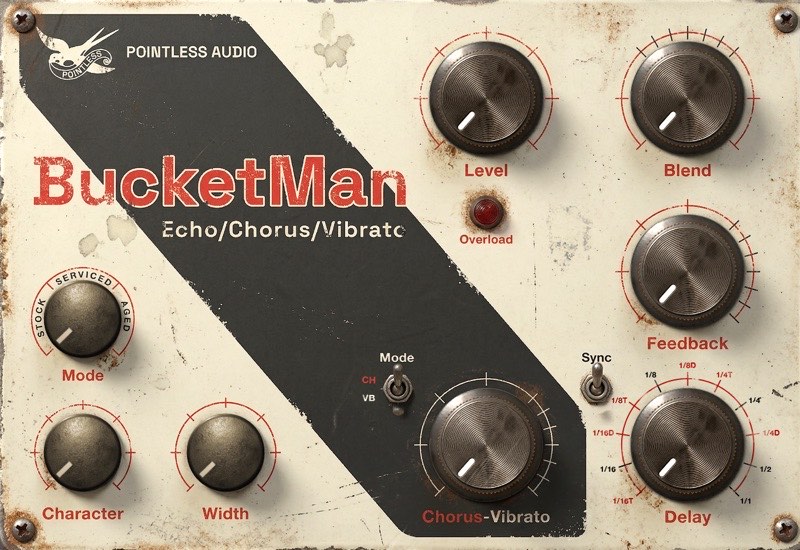
BucketMan's controls fall into four groups: the delay core, the modulation, the machine's character, and tempo sync. Everything is automatable.
CORE
| Parameter | Range | Default | What it does |
|---|---|---|---|
| DELAY | 20-550 ms | 300 ms | Delay time. Longer settings sound darker and murkier |
| FEEDBACK | 0-100% | 30% | How many repeats — into self-oscillation near the top |
| BLEND | 0-100% | 30% | Dry / wet balance. The dry is always there |
| LEVEL | 0-100% | 33% (unity) | Input drive. Unity around a third up; higher pushes the repeats harder |
| WIDTH | 0-100% | 50% | Stereo spread. 0 = mono |
DELAY — sets the repeat time. Like the real thing, the longer the delay the darker and grainier each repeat becomes, so long settings smear into the background while short ones stay present and clear.
FEEDBACK — how many times the signal repeats. Low is a slap or a couple of echoes; past three-quarters the repeats barely decay, and near the top the delay tips into self-oscillation and starts to howl. It stays musical right up to the edge.
BLEND — the balance between your dry signal and the echoes. It works the same in both chorus and vibrato modes — the dry is never taken away.
LEVEL — how hard you drive the input. Unity sits around a third of the way up; turn it higher to push more signal into the compressor, which thickens and compresses the repeats.
WIDTH — the stereo spread of the wet signal. At zero it's mono; open it up and the repeats widen, with a subtle shimmer even at low settings so the delay never sits perfectly still. The dry stays centred.
MODULATION
| Parameter | Range | Default | What it does |
|---|---|---|---|
| CHORUS-VIBRATO | 0-100% | 0% | Modulation depth — wobble on the repeats |
| CHR / VIB | toggle | CHR | Chorus (slow, lush) or Vibrato (faster, deeper) |
CHORUS-VIBRATO — the depth of the pitch wobble on the delayed signal. Off leaves the repeats steady; turn it up for anything from a gentle shimmer to a seasick warble.
CHR / VIB — switches the wobble between two speeds. CHR is the slow, lush chorus the DMM is loved for; VIB is faster and more pronounced. The dry signal stays put in both, and both are stereo unless you pull WIDTH to zero.
CHARACTER
| Parameter | Range | Default | What it does |
|---|---|---|---|
| CHARACTER | 0-100% | 50% | One knob from clean to pumping, gritty and dark |
| MODE | Stock / Serviced / Aged | Stock | The machine's overall condition |
CHARACTER — a single macro that takes the machine from clean and well-behaved to worn and unruly. As you turn it up it loosens the compander (more pump and breathe on the repeats), brings in clock noise and bucket-brigade grit, adds saturation to the feedback, and darkens the tone — all at once. The centre is neutral; both extremes are pushed hard.
MODE — three versions of the same machine at different points in its life. Click to cycle through them.
| Mode | Character |
|---|---|
| Stock | Factory-fresh. Honest, a little noisy, full bucket-brigade character |
| Serviced | Recapped and calibrated. Cleaner, tighter, brighter and quieter |
| Aged | Twenty years in a garage. Wobbly, mismatched, dark and noisy |
SYNC
| Parameter | Range | Default | What it does |
|---|---|---|---|
| SYNC | toggle | Off | Locks DELAY to the host tempo |
With SYNC on, the DELAY knob snaps to musical divisions of the host tempo — from a 1/16 triplet up to a whole note, including dotted and triplet values — clamped to the delay's range.
BYPASS
Hard bypass — the signal passes through unprocessed, with no repeats and no tail.
Factory presets
| # | Preset | Description |
|---|---|---|
| 1 | The edge | Dotted eighth sync, clean, wide |
| 2 | Slap | Short single bounce, rockabilly. Serviced |
| 3 | Molten chorus | Dense chorus with feedback, depth high. Serviced |
| 4 | Seasick | Slow pitch-shift Doppler, unstable. Stock |
| 5 | Runaway | Just before self-oscillation. Dangerous territory |
| 6 | Sunday morning | Clean, wide, relaxed. Doesn't compete with the dry |
| 7 | Quarter | Max delay (550 ms), subtle chorus, low character. Stock |
| 8 | Infinite hallway | Long tails, wide, deep modulation. Serviced |
| 9 | Broken unit | Everything cranked. Controlled chaos. Aged |
| 10 | Ghost notes | Barely there repeats, subtle and wide. Stock |
Overload LED
The red LED tracks the feedback level, glowing brighter as the repeats build:
| Frame | Meaning |
|---|---|
| 0 | Silence / no feedback |
| 1 | First flicker — feedback just audible |
| 2 | Normal — repeats active, clean |
| 3 | Approaching the edge |
| 4 | Sustained repeats, slight compression |
| 5 | Approaching self-oscillation |
| 6 | Runaway entering — controlled chaos |
| 7 | Runaway — self-oscillation / bloom |
Watch it to dial FEEDBACK in just below self-oscillation — frames 5-6 are the sweet spot for sustained musical chaos without blowing up.
How it works
You don't need any of this to use BucketMan — but if you're curious what's inside the box:
The bucket brigade is where the delay comes from. Instead of a clean digital buffer, the signal is passed hand-to-hand down a long chain of analog stages, losing a little top end at every step. That's why the repeats darken and blur the longer the delay and the more they feed back — the murk a clean digital delay never gives you.
The compander fights the noise that chain would otherwise add: it squeezes the signal on the way in and expands it on the way out. The two halves never quite match, and that mismatch is the pump and breathe you hear on every repeat. CHARACTER loosens it; MODE sets how worn the whole machine is.
The modulation is a slow internal oscillator gently wobbling the delay time. A little of it turns the repeats into the DMM's signature chorus (CHR); more, and faster, becomes a deeper vibrato (VIB). Push FEEDBACK far enough and the repeats stop decaying and bloom into self-oscillation.
It's a model of the circuit rather than a tidy algorithm, which is why it drifts, darkens and occasionally runs away — on purpose.
Design notes
The repeats darken from the filters, not the clock. It's often assumed a bucket-brigade delay gets darker because its clock slows down. On a real Deluxe Memory Man the reconstruction filters set the tone, and they barely move across the delay range — so the darkening you hear as you lengthen the delay is the filter, taken from the real unit.
The compander mismatch is the sound. The two halves of the compander are deliberately mismatched. That mismatch is what makes the DMM pump and breathe on transients — a perfectly matched pair would erase the character entirely.
Three modes, one circuit. Stock, Serviced and Aged are the same hardware at different points in its life. The circuit doesn't change — only how worn the components are.
Vibrato is stereo. Many DMM emulations force vibrato to mono. BucketMan keeps it in stereo; set WIDTH to zero if you want the authentic mono pitch-shift.
Installation
macOS
Double-click the PA_BucketMan_macOS.pkg installer and follow it — the Customize step lets you pick VST3, AU and CLAP (for Bitwig, Reaper, MultitrackStudio). Formats install system-wide to /Library/Audio/Plug-Ins/VST3/, Components/ and CLAP/. Restart your DAW.
Note: The installer is signed with an Apple Developer ID and notarized by Apple — macOS opens it directly, with no security warnings.
Windows
Copy the PA BucketMan.vst3 folder to C:\Program Files\Common Files\VST3\.
Note: SmartScreen may warn — click "More info" → "Run anyway". Windows binary is not Authenticode signed.
Troubleshooting
Self-oscillation runs away on FEEDBACK > 85% — by design. The DMM self-oscillates around 85% of knob travel; above that the behaviour is intentionally wilder. Pull back to frame 5-6 on the overload LED for sustained musical chaos without blowing up.
Plugin doesn't appear in DAW — most DAWs rescan plugins on launch. In Logic Pro: Preferences → Plug-In Manager → Reset & Rescan. In Ableton: Preferences → Plug-Ins → Rescan. In Reaper: Preferences → Plug-ins → VST → Re-scan.
State doesn't persist between sessions — verify your DAW saves plugin state in the project. BucketMan uses APVTS standard, supported by every modern DAW.
Credits
- Inspired by the Electro-Harmonix Deluxe Memory Man. Tuned by ear against a real unit.
- Brand, name and visual language: Pointless Audio, 2026.
- Built with JUCE.
Support
Bug reports / feature requests: https://github.com/tweeedo911/PA_BucketMan/issues Web: https://pointlessaudio.studio
Pointless Audio pointlessaudio.studio
BucketMan is not affiliated with or endorsed by Electro-Harmonix / New Sensor Corporation. Electro-Harmonix, Memory Man, and Deluxe Memory Man are trademarks of New Sensor Corporation. This is an independent project inspired by the Electro-Harmonix Deluxe Memory Man.
© 2026 Pointless Audio · pointlessaudio.studio