AlphaRail
Manual
v0.4.4 · VST3 + AU + CLAP · macOS (Universal) + Windows 10+ (VST3 + CLAP)
What it does
AlphaRail is a faithful emulation of the input preamp section of the ARP 2600 — the 1971 semi-modular synthesizer designed by Alan R. Pearlman. Specifically it models the Teledyne 1339 op-amp closed-loop gain stage as it behaves when pushed past its 1971 specification.
Closed-loop gain stages built around the 1339 were never meant to be musical — they were utility amplifiers, intended to route external signals into the synth voice. Push one beyond spec and three things happen at once: the gain-bandwidth product collapses, the slew rate runs out, and the ±13V rails clip.
AlphaRail models that convergence honestly. Three RANGE positions — x10, x100, x1000 — each progressively further into the op-amp's failure modes. Bandwidth crashes from 100 kHz down to 1 kHz. Slew limit drops from 34 V/µs to under 1. At x1000 the unit is no longer a preamp: it is a bandlimit + slew + clip lo-fi shaper. We kept it.
This is not warm transistor saturation. It is not tube. It is what an op-amp sounds like when you ask it to do impossible things.
The ARP 2600 legacy
Designed in 1971 by Alan R. Pearlman, the ARP 2600 is the instrument behind Ben Burtt's voice for R2-D2 (Star Wars, 1977) and the Ark of the Covenant in Raiders of the Lost Ark (1981); Stevie Wonder's Innervisions (1973) and Songs in the Key of Life (1976) — his unit was famously labelled in Braille; Edgar Winter's Frankenstein (1972), played live with the synth worn around his neck; Pete Townshend on Quadrophenia (1973); the work of Joe Zawinul and Herbie Hancock in the same era.
AlphaRail models one specific stage of that machine — the input preamp op-amp pushed past spec. Not the filter, not the oscillators, not the spring reverb. The op-amp character, isolated and made playable on any source.
Parameters
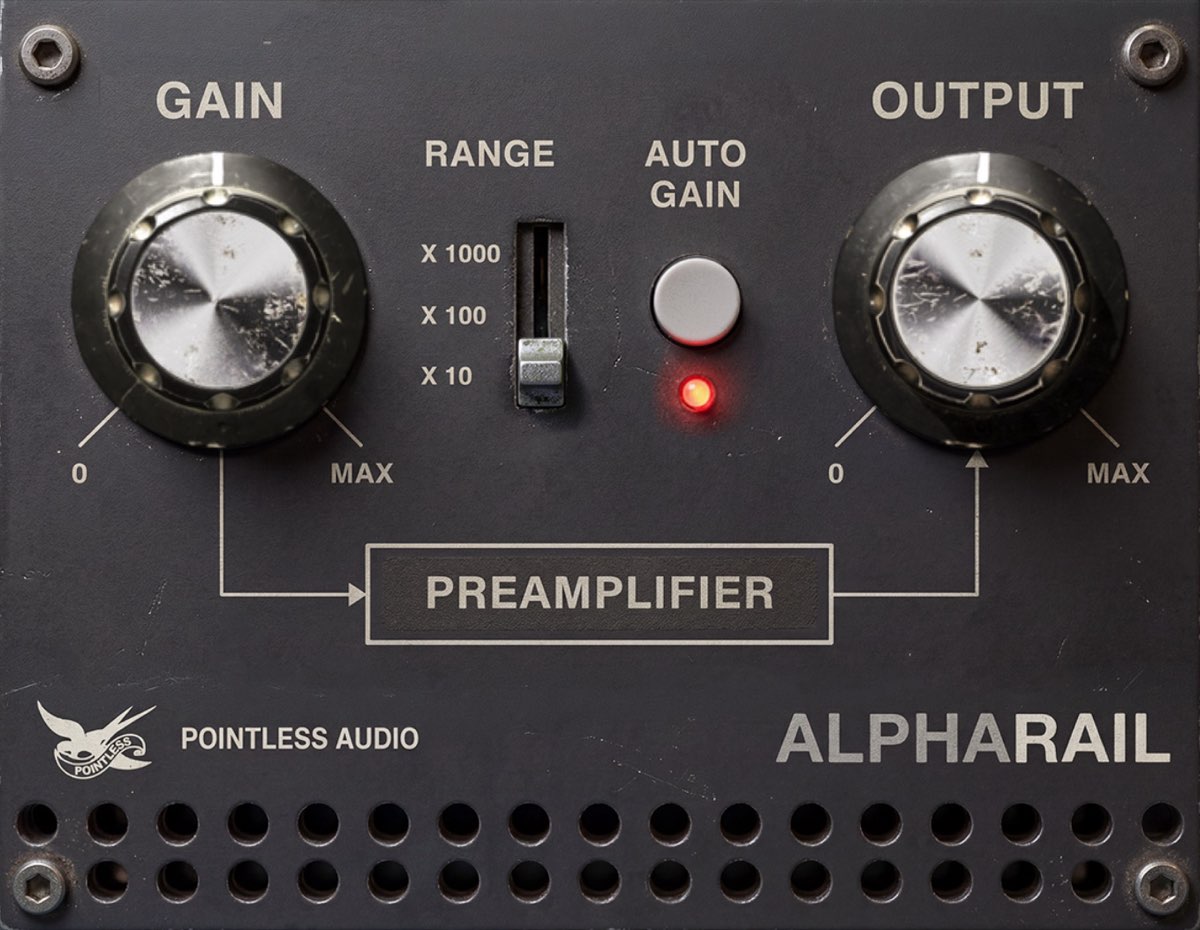
AlphaRail has four controls. RANGE sets the character; GAIN sets how hard you drive it; OUTPUT and AUTOGAIN handle level. All four are automatable.
| Parameter | Range | Default | What it does |
|---|---|---|---|
| GAIN | 0–100% | 55% | How hard you drive the stage |
| RANGE | 3 positions | x10 | How far past spec the op-amp runs — the single most character-defining control |
| OUTPUT | −24 / +24 dB | +4 dB | Makeup level after the character stage |
| AUTOGAIN | toggle | OFF | Holds the perceived level steady across GAIN and RANGE |
GAIN
How hard you push the stage. Low and it stays clean and transparent; around the default it settles into a light, sustained saturation with a little warmth; wide open it drives hard into the rail for a heavy, squared-off clip. It sets the amount of drive, not the loudness — that's what OUTPUT and AUTOGAIN are for.
RANGE
RANGE sets how far past spec the stage runs, and it defines the whole character. Switching positions isn't about loudness so much as what the circuit is physically doing.
| Position | Character |
|---|---|
| x10 | Cleanest — full range, just a touch of warmth |
| x100 | Mid character — audible bite, the top starting to close in |
| x1000 | Lo-fi shaper — the top end crashes, transients smear, peaks square off. The signature mode |
Click the lever to switch directly: top = x1000, mid = x100, bottom = x10.
OUTPUT
Makeup level after the character stage. Use it to recover any level lost through the drive, or to push whatever comes next. The default is set so the standard opening (GAIN around the default, RANGE x10, AUTOGAIN off) lands right about level with the dry signal — close to unity, not deceptively louder.
AUTOGAIN
A loudness match. Because x1000 naturally drops the level, changing RANGE would otherwise double as a volume jump. AUTOGAIN evens that out, so you can compare the three modes at the same loudness and hear only the character change.
- OFF (default). Total honesty: you hear exactly what RANGE does, including the level drop on x1000.
- ON. Perceived loudness held steady across the whole GAIN / RANGE sweep — the character switch stops doubling as a volume control. A red LED lights below the toggle.
Because it corrects the character only, AUTOGAIN won't chase the dynamics of your source. Reach for OUTPUT if you need further makeup.
Factory presets
Hint — Click the preset name in the bottom strip to switch. The A/B buttons compare the current state to an alternate snapshot. SAVE appears when the state is dirty.
| # | Name | GAIN | RANGE | OUTPUT | AUTOGAIN | Character |
|---|---|---|---|---|---|---|
| 1 | Init | 55% | x10 | +4 dB | OFF | Default entry. Light sustained sat, unity-to-+1 dB. |
| 2 | Clean glue | 30% | x10 | +16 dB | ON | Subtle warmth pervasive, no audible saturation. |
| 3 | Rail bite | 70% | x100 | +7 dB | ON | Mid character with audible even-harmonic bite (ARP-school signature). |
| 4 | GBW wall | 80% | x1000 | +10 dB | OFF | Lo-fi shaper signature. Identity mode. |
| 5 | Slew crush | 100% | x1000 | +4 dB | OFF | Maximalist. Slew limiting dominates the sound. |
User presets are stored in ~/Library/Audio/Pointless Audio/AlphaRail/Presets/ (macOS) or the Windows equivalent.
How it works
You don't need any of this to use AlphaRail — but if you're curious why it sounds the way it does:
It's an op-amp pushed past spec. The original stage was a plain utility amplifier, never meant to be driven hard. Ask it for far more gain than it was built for — that's what RANGE does — and three things give out at once.
The top end collapses. The more gain you demand, the less high frequency the stage can pass. At x10 it stays open and clean; by x1000 almost everything above the low mids is gone. That darkening is the circuit running out of headroom, not an EQ.
The slew rate runs out, then the rails clip. The stage can't swing fast enough to follow sharp transients, so they smear and soften; and when the signal reaches the supply rails it squares off. Those three failures together — lost highs, smeared transients, squared peaks — are the whole character. Take any one away and it disappears.
That's why x1000 isn't a "more drive" knob — it's a bandwidth-and-slew shaper. GAIN sets how hard you push in, OUTPUT makes up the level on the way out, and AUTOGAIN keeps things loudness-matched so the character switch doesn't double as a volume jump.
Design notes
Three failures, one character. What people call "warm saturation" in this kind of preamp is really three separate things giving out together — the top end collapsing, the transients smearing, and the peaks squaring off. Take any one away and the character is gone, which is why AlphaRail models all three rather than a single distortion curve.
x1000 is not "more saturation". It's a bandwidth-and-slew shaper. On sustained low material it strips the top away; on transients — snare, kick, percussive synth — it turns into a lo-fi shaper. Reach for it deliberately, not as a "more drive" setting.
Single emulation, honest. The original hardware shipped in three revisions that all share the same op-amp, and the differences between them are below the threshold of hearing on the unit itself. Modelling three "personalities" tuned by ear would be dishonest. AlphaRail is a single, honest emulation — free, with room to expand later if the audience asks.
Honest defaults. AUTOGAIN defaults OFF so you hear the real behaviour of RANGE, level drop and all. The default OUTPUT sits close to unity rather than deceptively loud.
Installation
macOS
Double-click the PA_AlphaRail_macOS.pkg installer to launch it.
Note: The installer is signed with an Apple Developer ID and notarized by Apple — macOS opens it directly, with no security warnings.
VST3 installs to /Library/Audio/Plug-Ins/VST3/, AU to /Library/Audio/Plug-Ins/Components/, CLAP (for Bitwig, Reaper, MultitrackStudio) to /Library/Audio/Plug-Ins/CLAP/. The Customize step in the installer lets you pick the formats.
Windows
Copy the PA AlphaRail.vst3 folder to C:\Program Files\Common Files\VST3\.
Note: SmartScreen may warn — click "More info" → "Run anyway". Windows binary is not Authenticode signed.
Troubleshooting
CPU usage seems high on x1000 — expected. At x1000 the bandwidth collapses further, the slew limiter works harder, and the shaper runs deep into its most nonlinear region — all more work per sample. Raise the buffer size if needed.
Plugin doesn't appear in DAW — most DAWs rescan plugins on launch. In Logic Pro: Preferences → Plug-In Manager → Reset & Rescan. In Ableton: Preferences → Plug-Ins → Rescan. In Reaper: Preferences → Plug-ins → VST → Re-scan.
State doesn't persist between sessions — verify your DAW saves plugin state in the project. AlphaRail uses APVTS standard, supported by every modern DAW.
Credits
- Inspired by the input preamp section of the ARP 2600 (1971). Tuned by ear against a real ARP 2600 preamp.
- Brand, name and visual language: Pointless Audio, 2026.
- Built with JUCE.
Support
Bug reports / feature requests: https://github.com/tweeedo911/AlphaRail/issues Web: https://pointlessaudio.studio
Pointless Audio pointlessaudio.studio
AlphaRail is not affiliated with or endorsed by ARP Instruments, Korg, or any synthesizer manufacturer. ARP and ARP 2600 are trademarks of their respective owners. Teledyne is a trademark of Teledyne Technologies Inc. This is an independent project inspired by the heritage of a 1971 modular synth preamp section.
© 2026 Pointless Audio · pointlessaudio.studio